Calendar of Events
M Mon
T Tue
W Wed
T Thu
F Fri
S Sat
S Sun
0 events,
0 events,
0 events,
0 events,
0 events,
0 events,
0 events,
0 events,
0 events,
0 events,
0 events,
0 events,
0 events,
0 events,
0 events,
0 events,
0 events,
0 events,
0 events,
0 events,
0 events,
0 events,
0 events,
0 events,
0 events,
0 events,
0 events,
0 events,
0 events,
0 events,
1 event,
FAH – DENG Guest Lecture: “Exploring AI-Enhanced Translation in Book Translation”
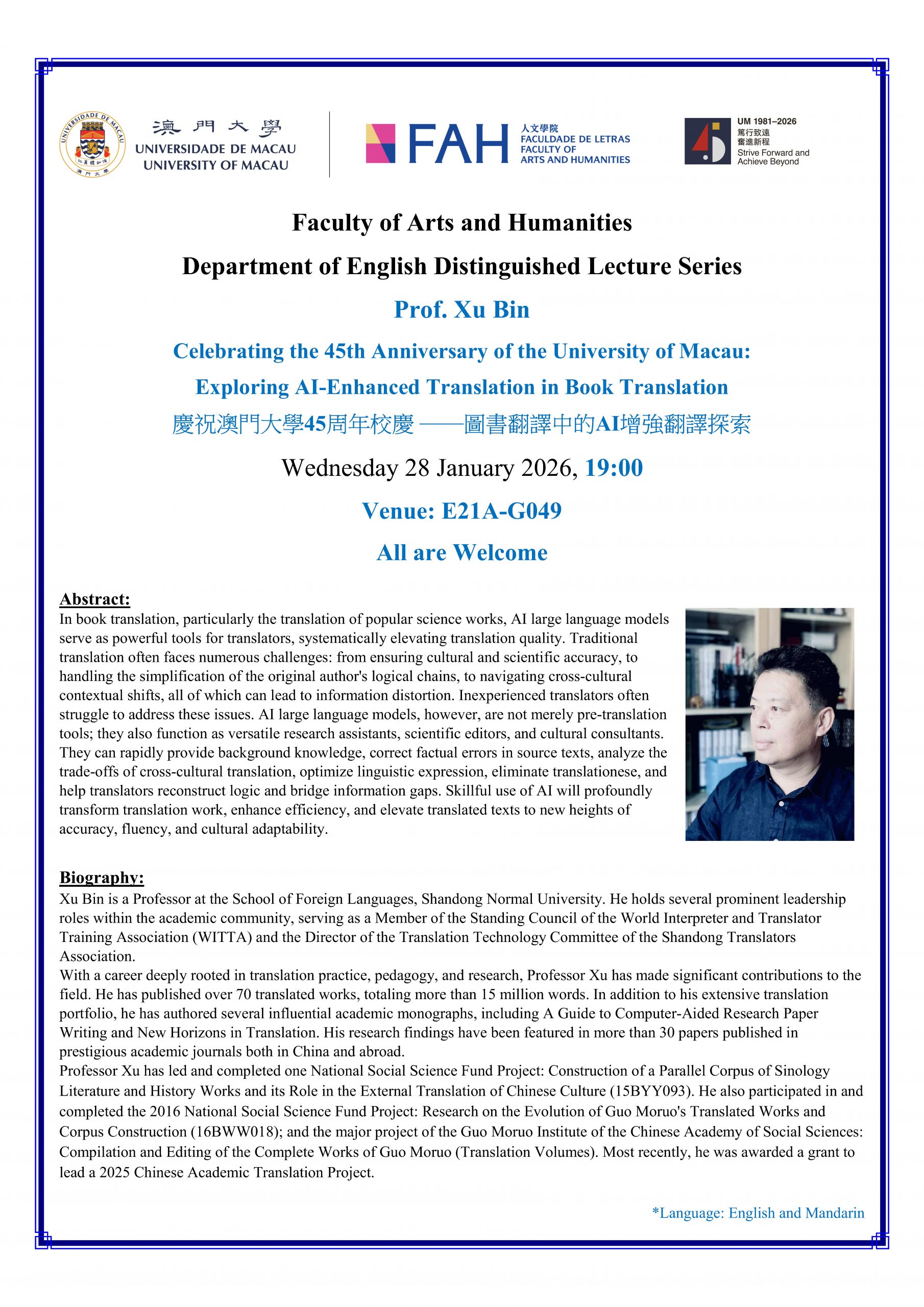
FAH – DENG Guest Lecture: “Exploring AI-Enhanced Translation in Book Translation”
Abstract: In book translation, particularly the translation of popular science works, AI large language models serve as powerful tools for translators, systematically elevating translation quality. Traditional translation often faces numerous challenges: from ensuring cultural and scientific accuracy, to handling the simplification of the original author's logical chains, to navigating cross-cultural contextual shifts, all of which can lead to information distortion. Inexperienced translators often struggle to address these issues. AI large language models, however, are not merely pre-translation tools; they also function as versatile research assistants, scientific editors, and cultural consultants. They can rapidly provide background knowledge, correct factual errors in source texts, analyze the trade-offs of cross-cultural translation, optimize linguistic expression, eliminate translationese, and help translators reconstruct logic and bridge […]
2 events,
FAH-DENG Guest Lecture: “From AIPE to AIAT: Translation in the Age of Artificial Intelligence”
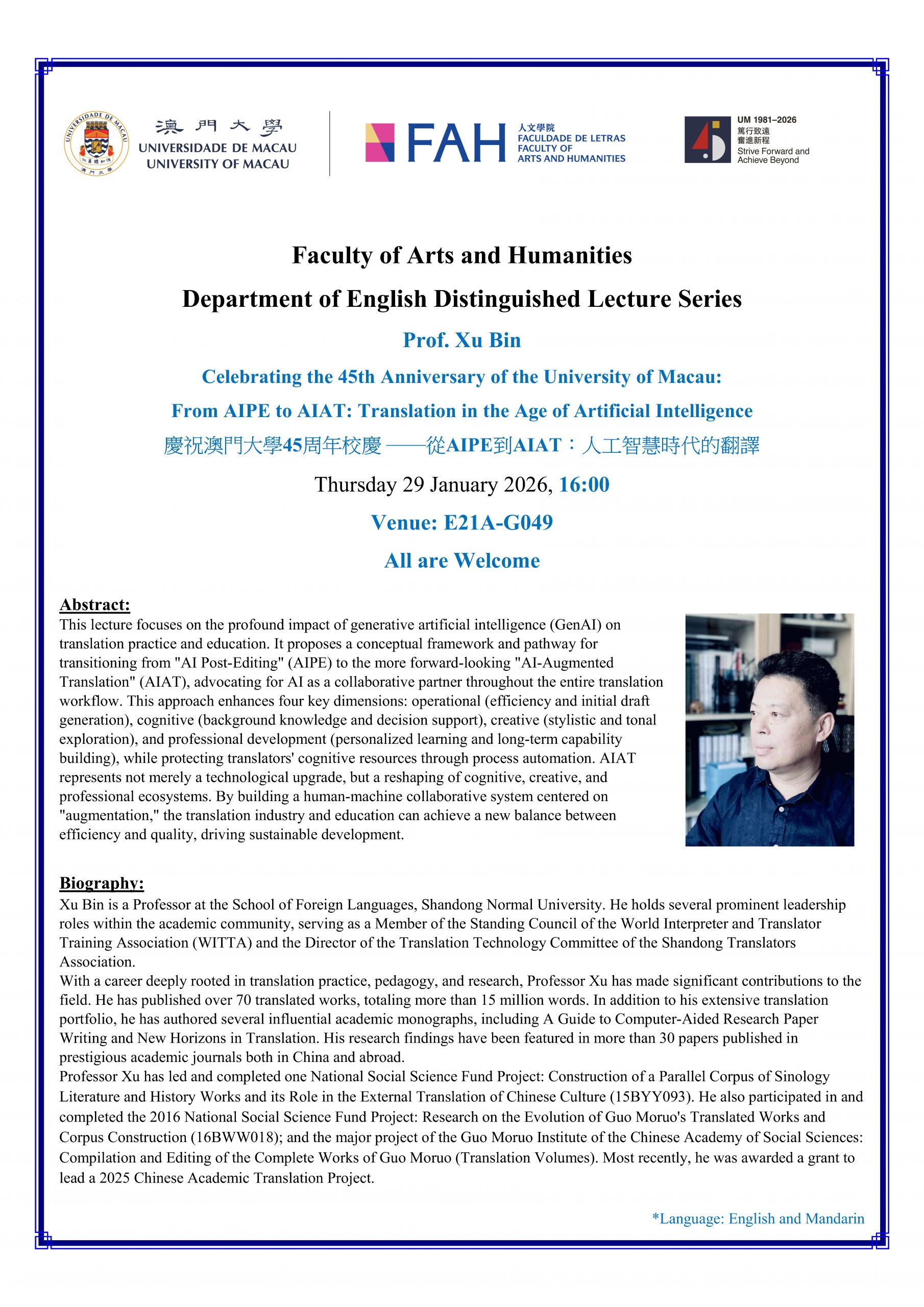
FAH-DENG Guest Lecture: “From AIPE to AIAT: Translation in the Age of Artificial Intelligence”
Abstract: This lecture focuses on the profound impact of generative artificial intelligence (GenAI) on translation practice and education. It proposes a conceptual framework and pathway for transitioning from "AI Post-Editing" (AIPE) to the more forward-looking "AI-Augmented Translation" (AIAT), advocating for AI as a collaborative partner throughout the entire translation workflow. This approach enhances four key dimensions: operational (efficiency and initial draft generation), cognitive (background knowledge and decision support), creative (stylistic and tonal exploration), and professional development (personalized learning and long-term capability building), while protecting translators' cognitive resources through process automation. AIAT represents not merely a technological upgrade, but a reshaping of cognitive, creative, and professional ecosystems. By building a human-machine collaborative system centered on "augmentation," the translation industry and education […]