

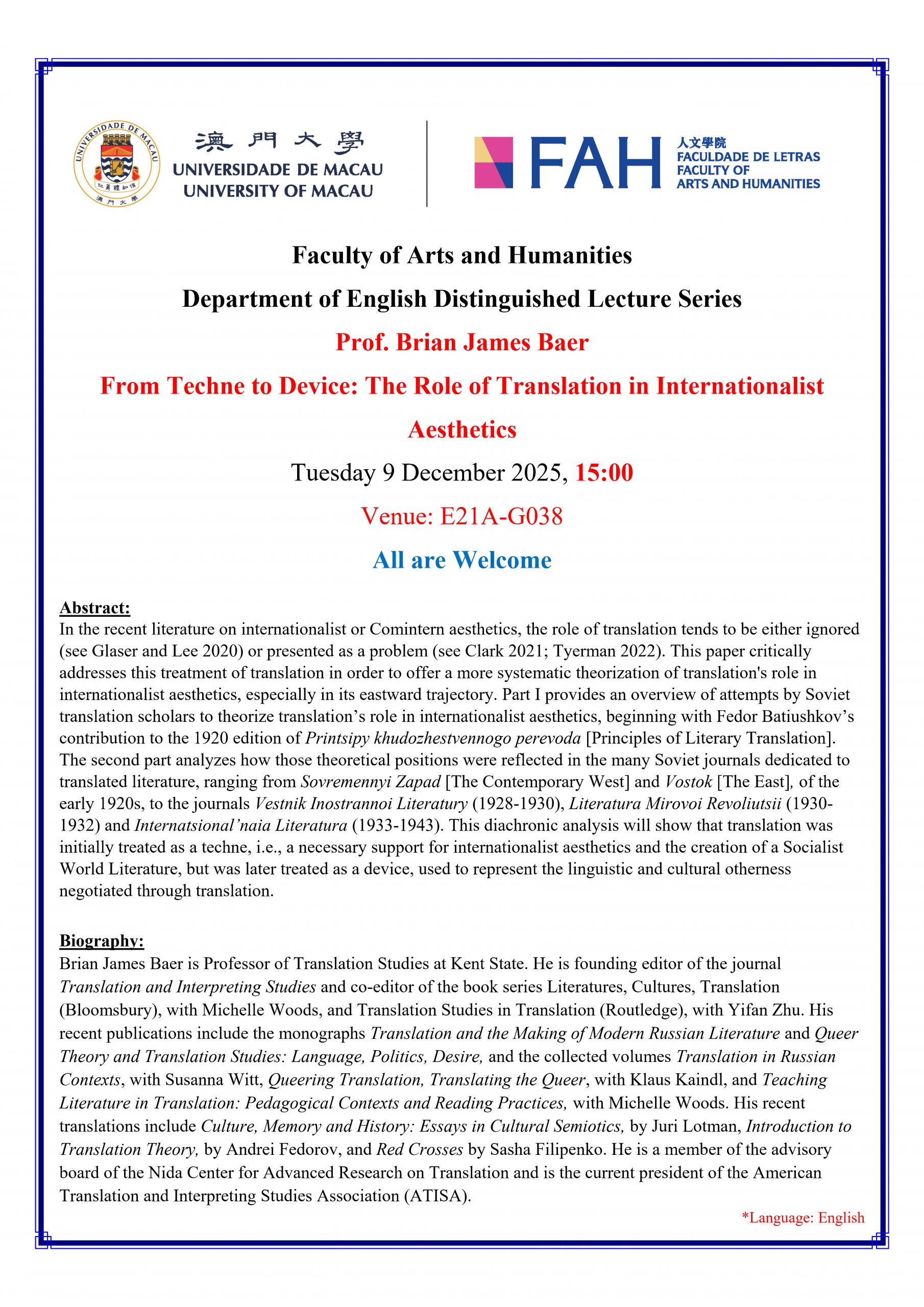
FAH-DENG Guest Lecture: “From Techne to Device: The Role of Translation in Internationalist Aesthetics”
2025-12-09 @ 3:00 pm ~ 4:30 pm
Abstract:
In the recent literature on internationalist or Comintern aesthetics, the role of translation tends to be either ignored (see Glaser and Lee 2020) or presented as a problem (see Clark 2021; Tyerman 2022). This paper critically addresses this treatment of translation in order to offer a more systematic theorization of translation’s role in internationalist aesthetics, especially in its eastward trajectory. Part I provides an overview of attempts by Soviet translation scholars to theorize translation’s role in internationalist aesthetics, beginning with Fedor Batiushkov’s contribution to the 1920 edition of Printsipy khudozhestvennogo perevoda [Principles of Literary Translation]. The second part analyzes how those theoretical positions were reflected in the many Soviet journals dedicated to translated literature, ranging from Sovremennyi Zapad [The Contemporary West] and Vostok [The East], of the early 1920s, to the journals Vestnik Inostrannoi Literatury (1928-1930), Literatura Mirovoi Revoliutsii (1930-1932) and Internatsional’naia Literatura (1933-1943). This diachronic analysis will show that translation was initially treated as a techne, i.e., a necessary support for internationalist aesthetics and the creation of a Socialist World Literature, but was later treated as a device, used to represent the linguistic and cultural otherness negotiated through translation.
Biography:
Brian James Baer is Professor of Translation Studies at Kent State. He is founding editor of the journal Translation and Interpreting Studies and co-editor of the book series Literatures, Cultures, Translation (Bloomsbury), with Michelle Woods, and Translation Studies in Translation (Routledge), with Yifan Zhu. His recent publications include the monographs Translation and the Making of Modern Russian Literature and Queer Theory and Translation Studies: Language, Politics, Desire, and the collected volumes Translation in Russian Contexts, with Susanna Witt, Queering Translation, Translating the Queer, with Klaus Kaindl, and Teaching Literature in Translation: Pedagogical Contexts and Reading Practices, with Michelle Woods. His recent translations include Culture, Memory and History: Essays in Cultural Semiotics, by Juri Lotman, Introduction to Translation Theory, by Andrei Fedorov, and Red Crosses by Sasha Filipenko. He is a member of the advisory board of the Nida Center for Advanced Research on Translation and is the current president of the American Translation and Interpreting Studies Association (ATISA).