
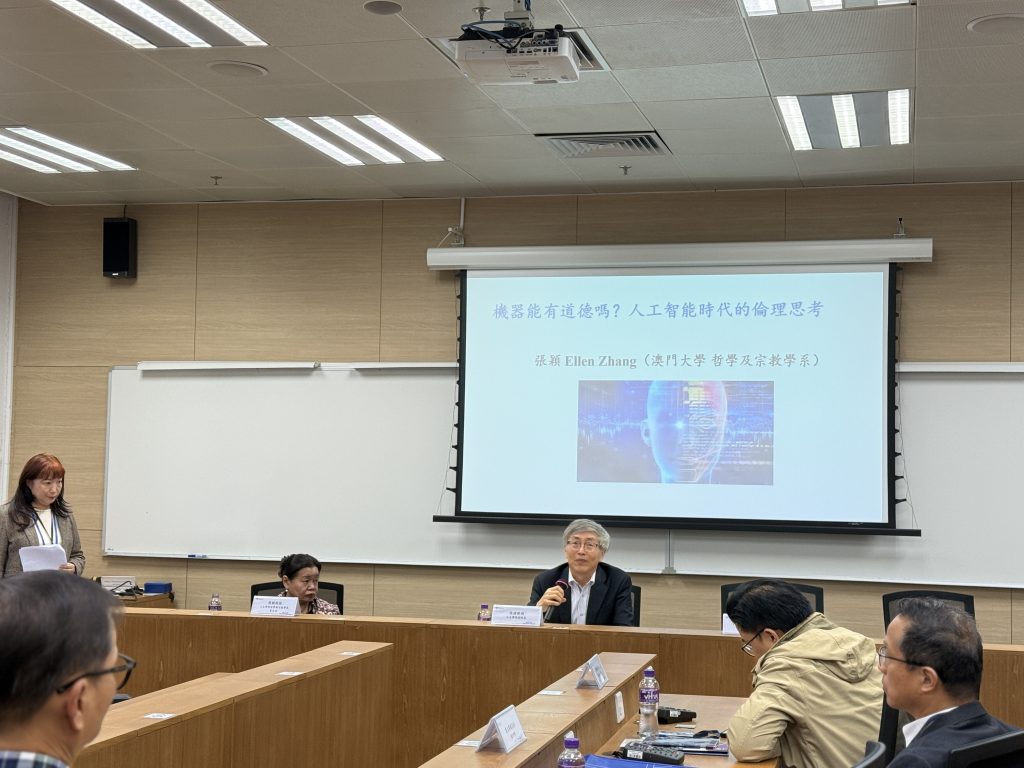
Professor Zhang Jian
To enhance collaboration and exchange between local schools and the Faculty of Arts and Humanities (FAH) at the University of Macau, FAH organized an event on December 5, 2025, that included an academic talk, a discussion session, and a dinner, attended by 15 representatives from 12 local secondary schools.
The event was hosted by Professor Victoria Lai Cheng Lei, Assistant Dean of FAH. Chair Professor Zhang Jian, Associate Dean of the Faculty, delivered a welcoming speech. In his speech, Professor Zhang Jian pointed out that we are currently in an era of rapid development in artificial intelligence, as AI has profoundly transformed life, society, and education. It serves as a powerful tool, helping students to learn more effectively and assisting teachers in enhancing teaching efficiency; yet, it also brings challenges. Using academic writing as an example, he illustrated how AI can instantly generate well-structured and even emotionally moving essays. This prompts educators to reflect: Is there still a need for writing classes? How can we preserve “genuine emotion” and the core values of education in the age of AI? Professor Zhang Jian emphasized that, from an art and humanities perspective, the core of education has always been the “human element.” We must integrate technology with humanistic values, cultivate students’ critical thinking, creativity, and ethical awareness, and ensure that AI becomes a force driving educational progress rather than replacing the essence of education.
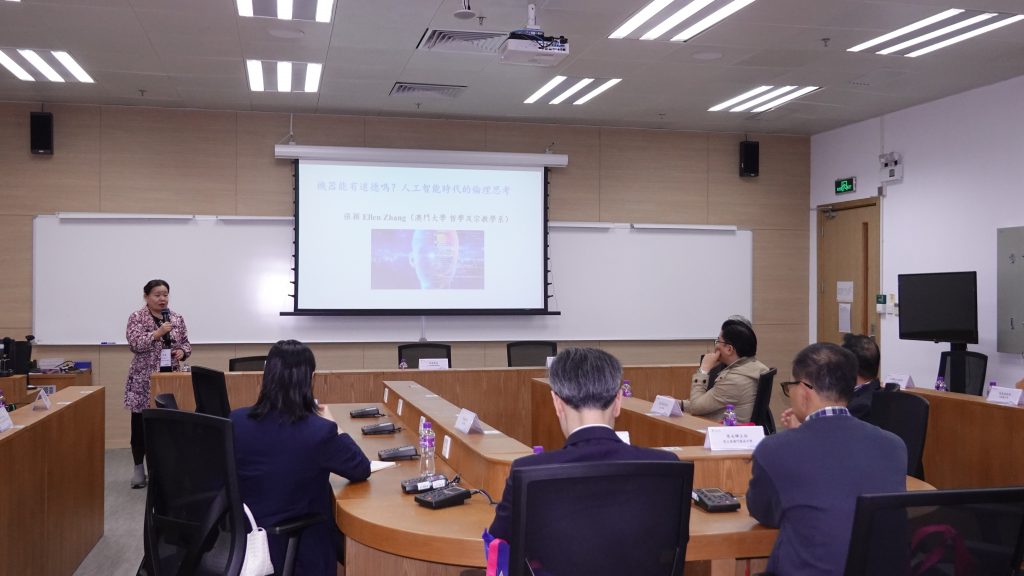
Professor Ellen Zhang
The academic lecture was presented by Professor Ellen Zhang Ying from the Department of Philosophy and Religious Studies, titled “Can Machines Have Morals? Ethical Reflections in the Age of Artificial Intelligence”. Professor Zhang delved deeply into the ethical challenges posed by AI, covering issues such as autonomous vehicles, the allocation of medical resources, military applications, and privacy protection. She raised the critical question of “accountability”: when an AI decision goes wrong, who should be held responsible—the designer, the data provider, the user, or the AI itself? She pointed out that AI still lacks moral reasoning in the human sense; therefore, it is essential to ensure that AI behavior aligns with human values through both technological design and ethical frameworks. Professor Zhang emphasized that AI should be positioned as “Augmented Intelligence,” rather than merely “Artificial Intelligence,” aiming to assist rather than replace human cognition and decision-making. She called for interdisciplinary collaboration, integrating philosophy, ethics, law, sociology, and engineering to collectively shape a promising future that balances technological innovation with humanistic care.
During the follow-up discussion session and dinner, representatives from various schools engaged in lively exchanges with the speaker and members of FAH, furthering dialogue on the topics presented.