

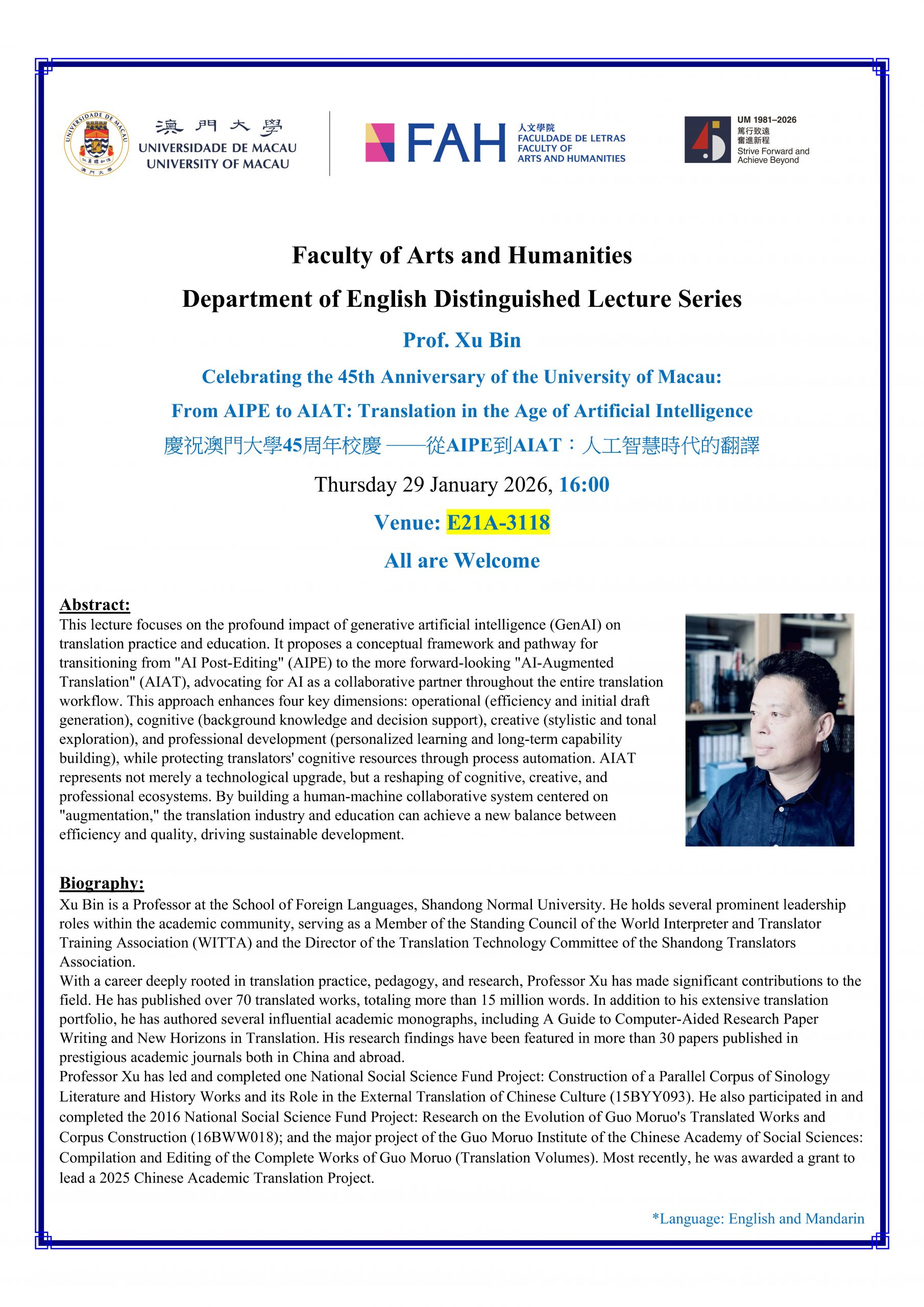
FAH-DENG Guest Lecture: “From AIPE to AIAT: Translation in the Age of Artificial Intelligence”
2026-01-29 @ 4:00 pm ~ 4:30 pm
Abstract:
This lecture focuses on the profound impact of generative artificial intelligence (GenAI) on translation practice and education. It proposes a conceptual framework and pathway for transitioning from “AI Post-Editing” (AIPE) to the more forward-looking “AI-Augmented Translation” (AIAT), advocating for AI as a collaborative partner throughout the entire translation workflow. This approach enhances four key dimensions: operational (efficiency and initial draft generation), cognitive (background knowledge and decision support), creative (stylistic and tonal exploration), and professional development (personalized learning and long-term capability building), while protecting translators’ cognitive resources through process automation. AIAT represents not merely a technological upgrade, but a reshaping of cognitive, creative, and professional ecosystems. By building a human-machine collaborative system centered on “augmentation,” the translation industry and education can achieve a new balance between efficiency and quality, driving sustainable development.
Biography:
Xu Bin is a Professor at the School of Foreign Languages, Shandong Normal University. He holds several prominent leadership roles within the academic community, serving as a Member of the Standing Council of the World Interpreter and Translator Training Association (WITTA) and the Director of the Translation Technology Committee of the Shandong Translators Association.
With a career deeply rooted in translation practice, pedagogy, and research, Professor Xu has made significant contributions to the field. He has published over 70 translated works, totaling more than 15 million words. In addition to his extensive translation portfolio, he has authored several influential academic monographs, including A Guide to Computer-Aided Research Paper Writing and New Horizons in Translation. His research findings have been featured in more than 30 papers published in prestigious academic journals both in China and abroad.
Professor Xu has led and completed one National Social Science Fund Project: Construction of a Parallel Corpus of Sinology Literature and History Works and its Role in the External Translation of Chinese Culture (15BYY093). He also participated in and completed the 2016 National Social Science Fund Project: Research on the Evolution of Guo Moruo’s Translated Works and Corpus Construction (16BWW018); and the major project of the Guo Moruo Institute of the Chinese Academy of Social Sciences: Compilation and Editing of the Complete Works of Guo Moruo (Translation Volumes). Most recently, he was awarded a grant to lead a 2025 Chinese Academic Translation Project.