

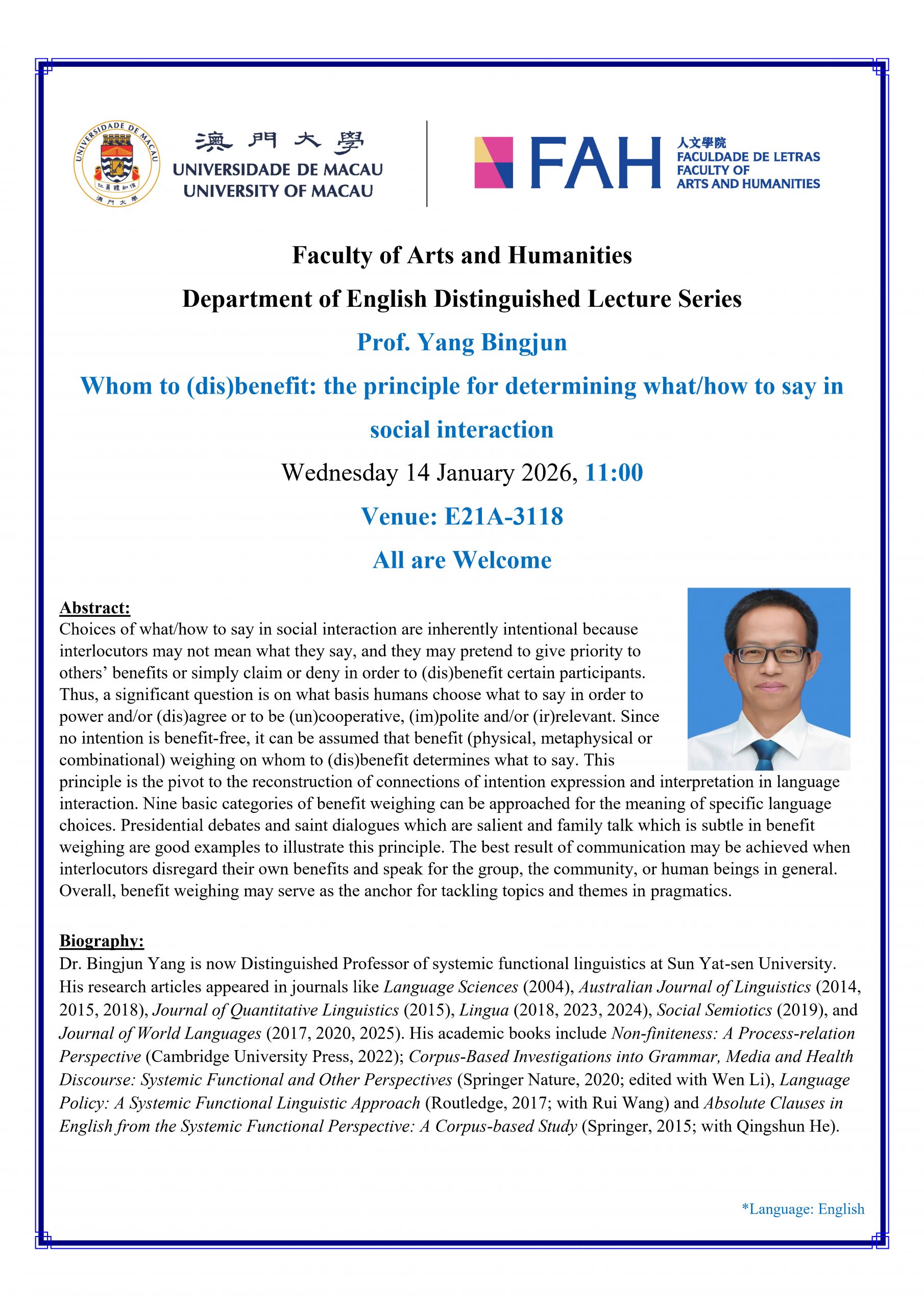
FAH-DENG Guest Lecture: “Whom to (dis)benefit: the principle for determining what/how to say in social interaction”
2026-01-14 @ 11:00 am ~ 12:00 pm
Abstract:
Choices of what/how to say in social interaction are inherently intentional because interlocutors may not mean what they say, and they may pretend to give priority to others’ benefits or simply claim or deny in order to (dis)benefit certain participants. Thus, a significant question is on what basis humans choose what to say in order to power and/or (dis)agree or to be (un)cooperative, (im)polite and/or (ir)relevant. Since no intention is benefit-free, it can be assumed that benefit (physical, metaphysical or combinational) weighing on whom to (dis)benefit determines what to say. This principle is the pivot to the reconstruction of connections of intention expression and interpretation in language interaction. Nine basic categories of benefit weighing can be approached for the meaning of specific language choices. Presidential debates and saint dialogues which are salient and family talk which is subtle in benefit weighing are good examples to illustrate this principle. The best result of communication may be achieved when interlocutors disregard their own benefits and speak for the group, the community, or human beings in general. Overall, benefit weighing may serve as the anchor for tackling topics and themes in pragmatics.
Biography:
Dr. Bingjun Yang is now Distinguished Professor of systemic functional linguistics at Sun Yat-sen University. His research articles appeared in journals like Language Sciences (2004), Australian Journal of Linguistics (2014, 2015, 2018), Journal of Quantitative Linguistics (2015), Lingua (2018, 2023, 2024), Social Semiotics (2019), and Journal of World Languages (2017, 2020, 2025). His academic books include Non-finiteness: A Process-relation Perspective (Cambridge University Press, 2022); Corpus-Based Investigations into Grammar, Media and Health Discourse: Systemic Functional and Other Perspectives (Springer Nature, 2020; edited with Wen Li), Language Policy: A Systemic Functional Linguistic Approach (Routledge, 2017; with Rui Wang) and Absolute Clauses in English from the Systemic Functional Perspective: A Corpus-based Study (Springer, 2015; with Qingshun He).