

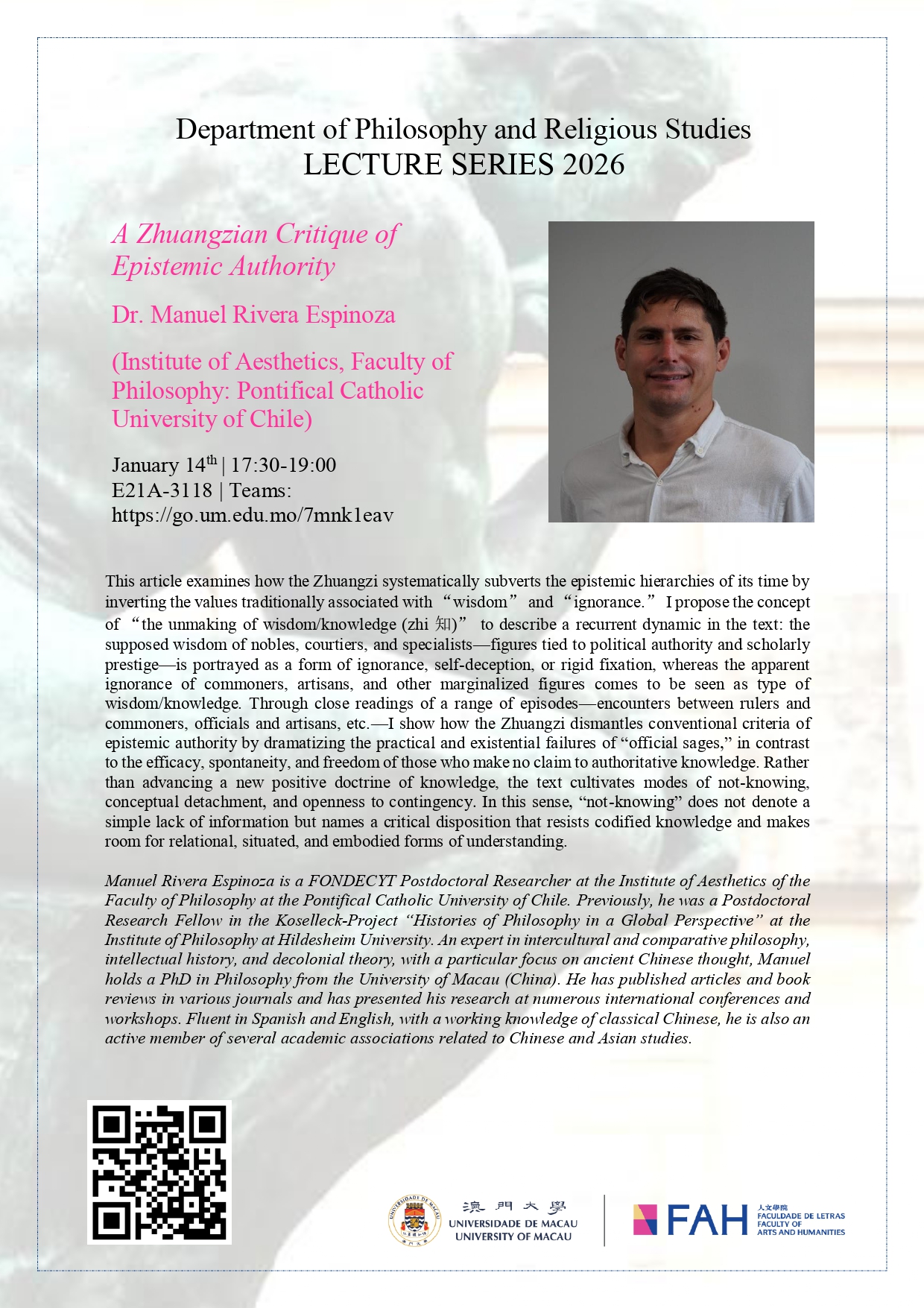
FAH/DPHIL Lecture Series – “A Zhuangzian Critique of Epistemic Authority” by Dr. Manuel Rivera Espinoza, Pontifical Catholic University of Chile, Chile
2026-01-14 @ 5:30 pm ~ 7:00 pm
Microsoft Teams: https://go.um.edu.mo/7mnk1eav
Abstract
This article examines how the Zhuangzi systematically subverts the epistemic hierarchies of its time by inverting the values traditionally associated with “wisdom” and “ignorance.” I propose the concept of “the unmaking of wisdom/knowledge (zhi 知)” to describe a recurrent dynamic in the text: the supposed wisdom of nobles, courtiers, and specialists—figures tied to political authority and scholarly prestige—is portrayed as a form of ignorance, self-deception, or rigid fixation, whereas the apparent ignorance of commoners, artisans, and other marginalized figures comes to be seen as type of wisdom/knowledge. Through close readings of a range of episodes—encounters between rulers and commoners, officials and artisans, etc.—I show how the Zhuangzi dismantles conventional criteria of epistemic authority by dramatizing the practical and existential failures of “official sages,” in contrast to the efficacy, spontaneity, and freedom of those who make no claim to authoritative knowledge. Rather than advancing a new positive doctrine of knowledge, the text cultivates modes of not-knowing, conceptual detachment, and openness to contingency. In this sense, “not-knowing” does not denote a simple lack of information but names a critical disposition that resists codified knowledge and makes room for relational, situated, and embodied forms of understanding.
Bio
Manuel Rivera Espinoza is a FONDECYT Postdoctoral Researcher at the Institute of Aesthetics of the Faculty of Philosophy at the Pontifical Catholic University of Chile. Previously, he was a Postdoctoral Research Fellow in the Koselleck-Project “Histories of Philosophy in a Global Perspective” at the Institute of Philosophy at Hildesheim University. An expert in intercultural and comparative philosophy, intellectual history, and decolonial theory, with a particular focus on ancient Chinese thought, Manuel holds a PhD in Philosophy from the University of Macau (China). He has published articles and book reviews in various journals and has presented his research at numerous international conferences and workshops. Fluent in Spanish and English, with a working knowledge of classical Chinese, he is also an active member of several academic associations related to Chinese and Asian studies.