

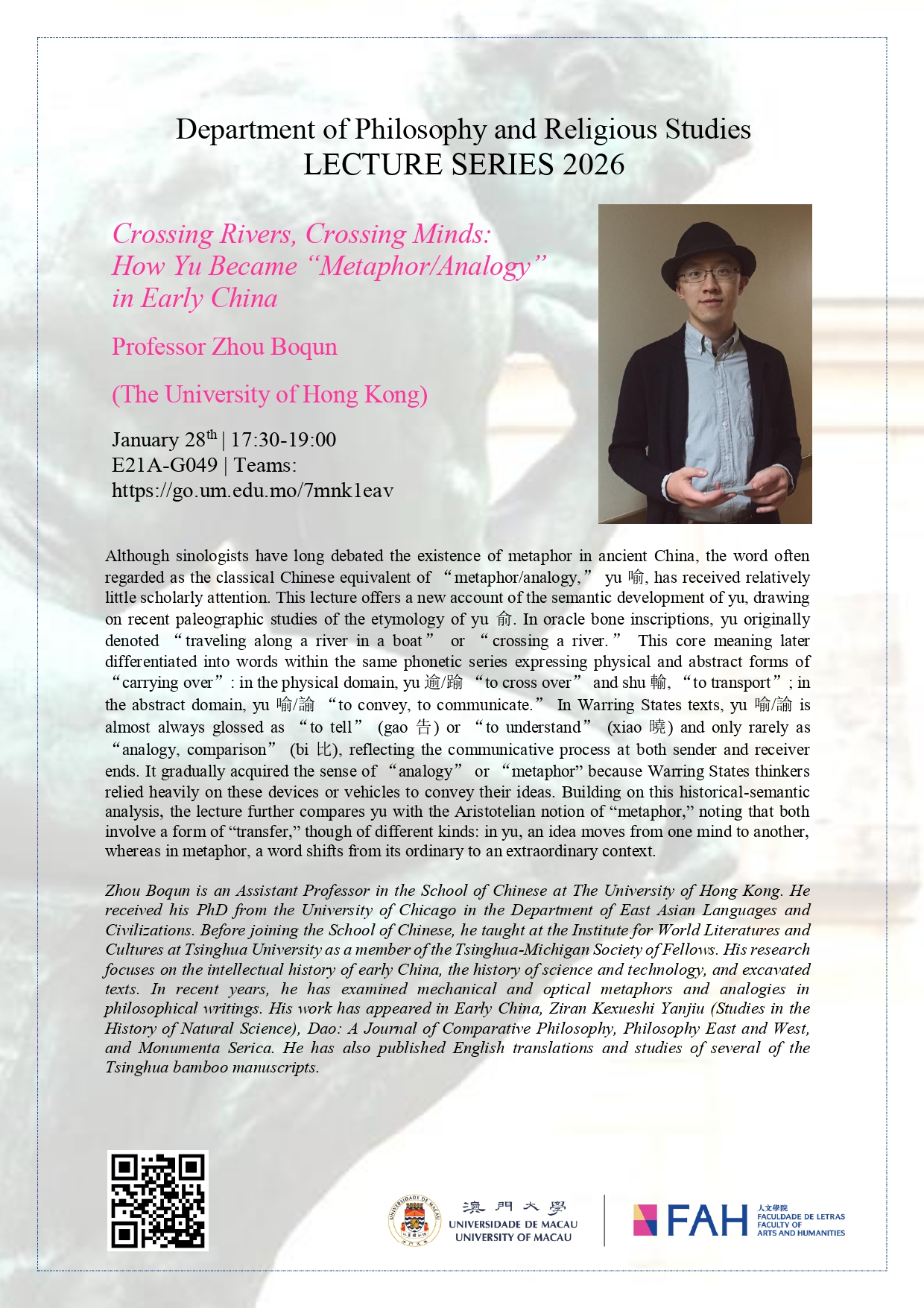
FAH/DPHIL Lecture Series – “Crossing Rivers, Crossing Minds: How Yu Became “Metaphor/Analogy” in Early China” by Prof. Zhou Boqun, The University of Hong Kong, Hong Kong
2026-01-28 @ 5:30 pm ~ 7:00 pm
Microsoft Teams: https://go.um.edu.mo/7mnk1eav
Abstract
Although sinologists have long debated the existence of metaphor in ancient China, the word often regarded as the classical Chinese equivalent of “metaphor/analogy,” yu 喻, has received relatively little scholarly attention. This lecture offers a new account of the semantic development of yu, drawing on recent paleographic studies of the etymology of yu 俞. In oracle bone inscriptions, yu originally denoted “traveling along a river in a boat” or “crossing a river.” This core meaning later differentiated into words within the same phonetic series expressing physical and abstract forms of “carrying over”: in the physical domain, yu 逾/踰 “to cross over” and shu 輸, “to transport”; in the abstract domain, yu 喻/諭 “to convey, to communicate.” In Warring States texts, yu 喻/諭 is almost always glossed as “to tell” (gao 告) or “to understand” (xiao 曉) and only rarely as “analogy, comparison” (bi 比), reflecting the communicative process at both sender and receiver ends. It gradually acquired the sense of “analogy” or “metaphor” because Warring States thinkers relied heavily on these devices or vehicles to convey their ideas. Building on this historical-semantic analysis, the lecture further compares yu with the Aristotelian notion of “metaphor,” noting that both involve a form of “transfer,” though of different kinds: in yu, an idea moves from one mind to another, whereas in metaphor, a word shifts from its ordinary to an extraordinary context.
Bio
Zhou Boqun is an Assistant Professor in the School of Chinese at The University of Hong Kong. He received his PhD from the University of Chicago in the Department of East Asian Languages and Civilizations. Before joining the School of Chinese, he taught at the Institute for World Literatures and Cultures at Tsinghua University as a member of the Tsinghua-Michigan Society of Fellows. His research focuses on the intellectual history of early China, the history of science and technology, and excavated texts. In recent years, he has examined mechanical and optical metaphors and analogies in philosophical writings. His work has appeared in Early China, Ziran Kexueshi Yanjiu (Studies in the History of Natural Science), Dao: A Journal of Comparative Philosophy, Philosophy East and West, and Monumenta Serica. He has also published English translations and studies of several of the Tsinghua bamboo manuscripts.