


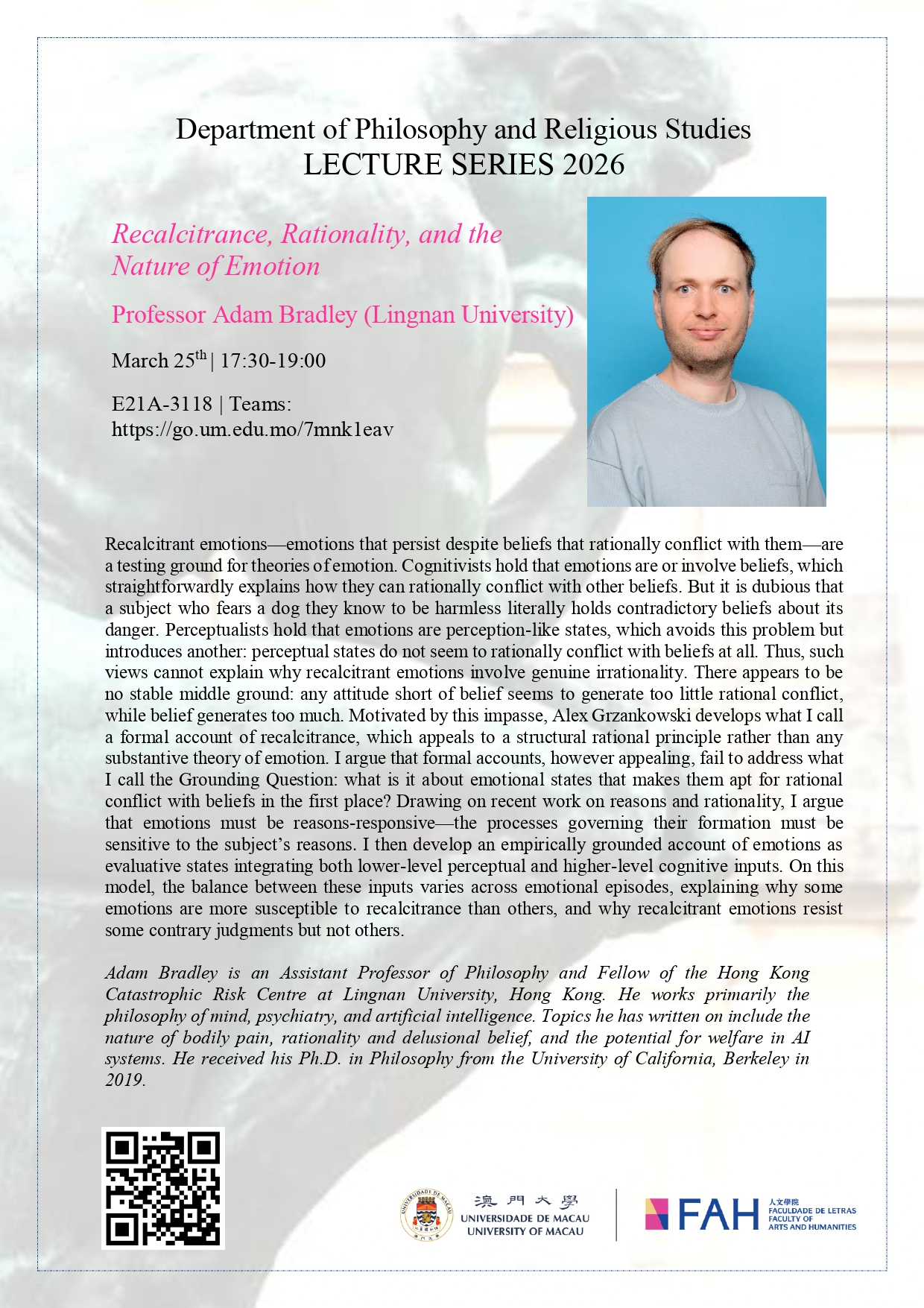
FAH/DPHIL Lecture Series – “Recalcitrance, Rationality, and the Nature of Emotion” by Prof. Adam Bradley, Lingnan University, Hong Kong
2026-03-25 @ 5:30 pm ~ 7:00 pm
Microsoft Teams: https://go.um.edu.mo/7mnk1eav
Abstract
Recalcitrant emotions—emotions that persist despite beliefs that rationally conflict with them—are a testing ground for theories of emotion. Cognitivists hold that emotions are or involve beliefs, which straightforwardly explains how they can rationally conflict with other beliefs. But it is dubious that a subject who fears a dog they know to be harmless literally holds contradictory beliefs about its danger. Perceptualists hold that emotions are perception-like states, which avoids this problem but introduces another: perceptual states do not seem to rationally conflict with beliefs at all. Thus, such views cannot explain why recalcitrant emotions involve genuine irrationality. There appears to be no stable middle ground: any attitude short of belief seems to generate too little rational conflict, while belief generates too much. Motivated by this impasse, Alex Grzankowski develops what I call a formal account of recalcitrance, which appeals to a structural rational principle rather than any substantive theory of emotion. I argue that formal accounts, however appealing, fail to address what I call the Grounding Question: what is it about emotional states that makes them apt for rational conflict with beliefs in the first place? Drawing on recent work on reasons and rationality, I argue that emotions must be reasons-responsive—the processes governing their formation must be sensitive to the subject’s reasons. I then develop an empirically grounded account of emotions as evaluative states integrating both lower-level perceptual and higher-level cognitive inputs. On this model, the balance between these inputs varies across emotional episodes, explaining why some emotions are more susceptible to recalcitrance than others, and why recalcitrant emotions resist some contrary judgments but not others.
Bio
Adam Bradley is an Assistant Professor of Philosophy and Fellow of the Hong Kong Catastrophic Risk Centre at Lingnan University, Hong Kong. He works primarily the philosophy of mind, psychiatry, and artificial intelligence. Topics he has written on include the nature of bodily pain, rationality and delusional belief, and the potential for welfare in AI systems. He received his Ph.D. in Philosophy from the University of California, Berkeley in 2019.