


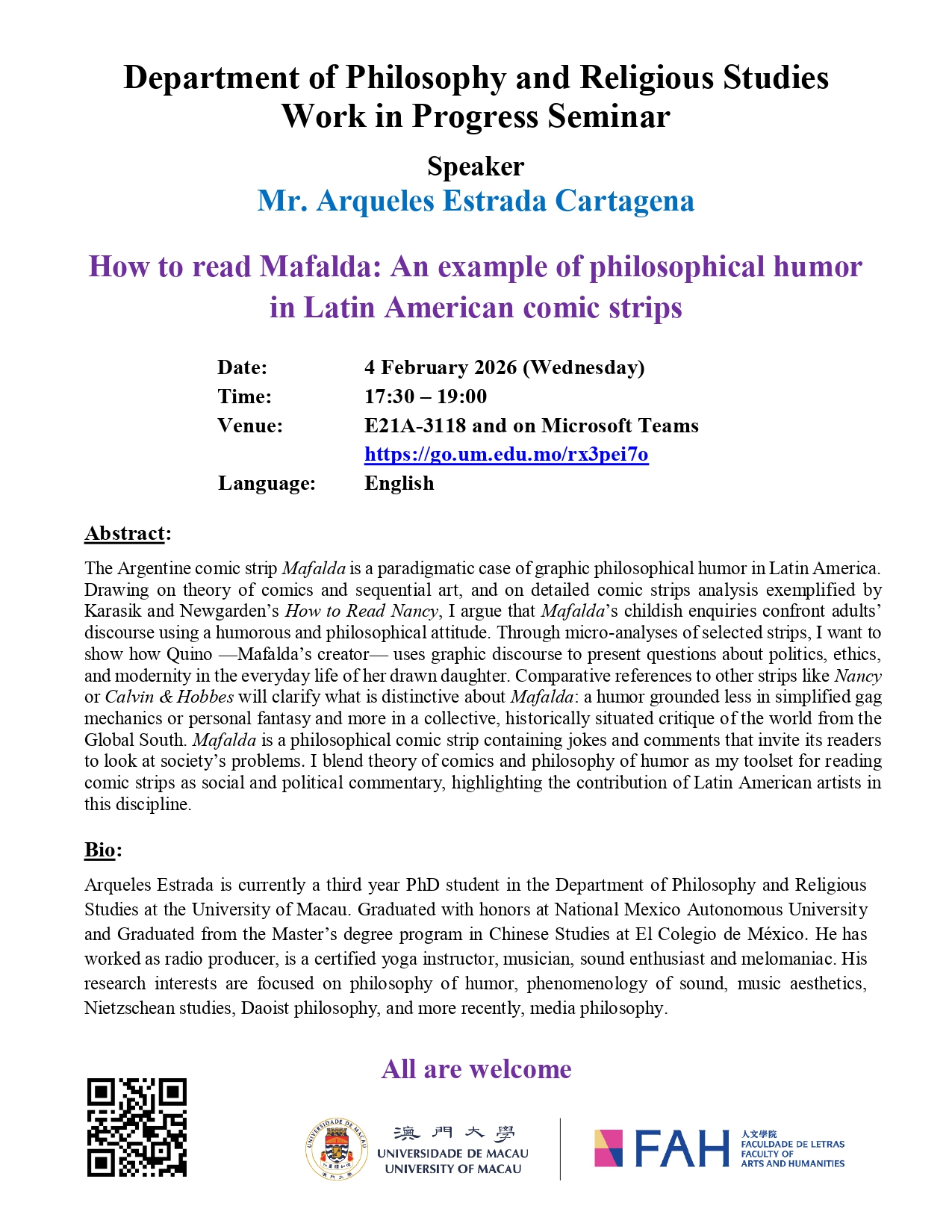
FAH/DPHIL Work-in-progress Seminar – “How to read Mafalda: An example of philosophical humor in Latin American comic strips” by Mr. Arqueles Estrada Cartagena
2026-02-04 @ 5:30 pm ~ 7:00 pm
Microsoft Teams: https://go.um.edu.mo/rx3pei7o
Abstract
The Argentine comic strip Mafalda is a paradigmatic case of graphic philosophical humor in Latin America. Drawing on theory of comics and sequential art, and on detailed comic strips analysis exemplified by Karasik and Newgarden’s How to Read Nancy, I argue that Mafalda’s childish enquiries confront adults’ discourse using a humorous and philosophical attitude. Through micro-analyses of selected strips, I want to show how Quino —Mafalda’s creator— uses graphic discourse to present questions about politics, ethics, and modernity in the everyday life of her drawn daughter. Comparative references to other strips like Nancy or Calvin & Hobbes will clarify what is distinctive about Mafalda: a humor grounded less in simplified gag mechanics or personal fantasy and more in a collective, historically situated critique of the world from the Global South. Mafalda is a philosophical comic strip containing jokes and comments that invite its readers to look at society’s problems. I blend theory of comics and philosophy of humor as my toolset for reading comic strips as social and political commentary, highlighting the contribution of Latin American artists in this discipline.
Bio
Arqueles Estrada is currently a third year PhD student in the Department of Philosophy and Religious Studies at the University of Macau. Graduated with honors at National Mexico Autonomous University and Graduated from the Master’s degree program in Chinese Studies at El Colegio de México. He has worked as radio producer, is a certified yoga instructor, musician, sound enthusiast and melomaniac. His research interests are focused on philosophy of humor, phenomenology of sound, music aesthetics, Nietzschean studies, Daoist philosophy, and more recently, media philosophy.