
On 18 March, 2026, the Department of Japanese at FAH hosted a guest lecture entitled “Japanese Folktales, The Taboo of No Looking, and the Breaking of the Curse of the ‘World.’” The lecture was given by Prof. Isomae Jun’ichi, professor of International Research Center for Japanese Studies in Kyoto, Japan. Prof. Isomae’s research fields include religious studies, critical theory, and intellectual history. This was his last lecture before retirement.

Prof. Isomae’s lecture revolves around the question of how we can liberate ourselves from the illusion of the world we live in and construct a viable subject position by engaging the Other that is however always evasive and often difficult to find or behold. He started by introducing several Japanese folktales that all contain a taboo that forbids looking. That which is not allowed to be seen is one example of the Other that helps constitute the human subject. Prof. Isomae then gave the examples of those who died during the earthquake and tsunami disasters in northeastern Japan in March 2011 as well as the pre-1945 history of Japanese imperialism in Asia. The dead bodies of family members and friends are unbearable to look at but it is also impossible to just ignore them. Japanese society in the postwar period has avoided looking at its own history, the Other inside, in order to maintain the illusion of Japan as a peaceful island country. Prof. Isomae ended his lecture by suggesting rather than avoiding the difficult task of confronting the Other, we should learn to “swim with the dead” thereby coming to terms with the Other and eventually the self as subject.
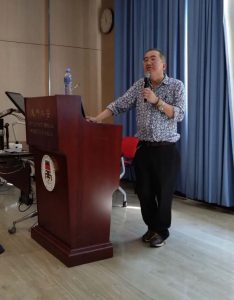
Around 90 students from the Department of Japanese and other departments attended Prof. Isomae’s lecture. After Prof. Isomae spoke for one hour, many students raised questions and observations about the lecture topic and the ongoing relationship between China and Japan. The Q & A session lasted 20 mins and was a lively exchange of ideas and opinions. Another professor from the International Research Center for Japanese Studies, Nakamaru Takahumi, also joined the lecture and offered his comments.