

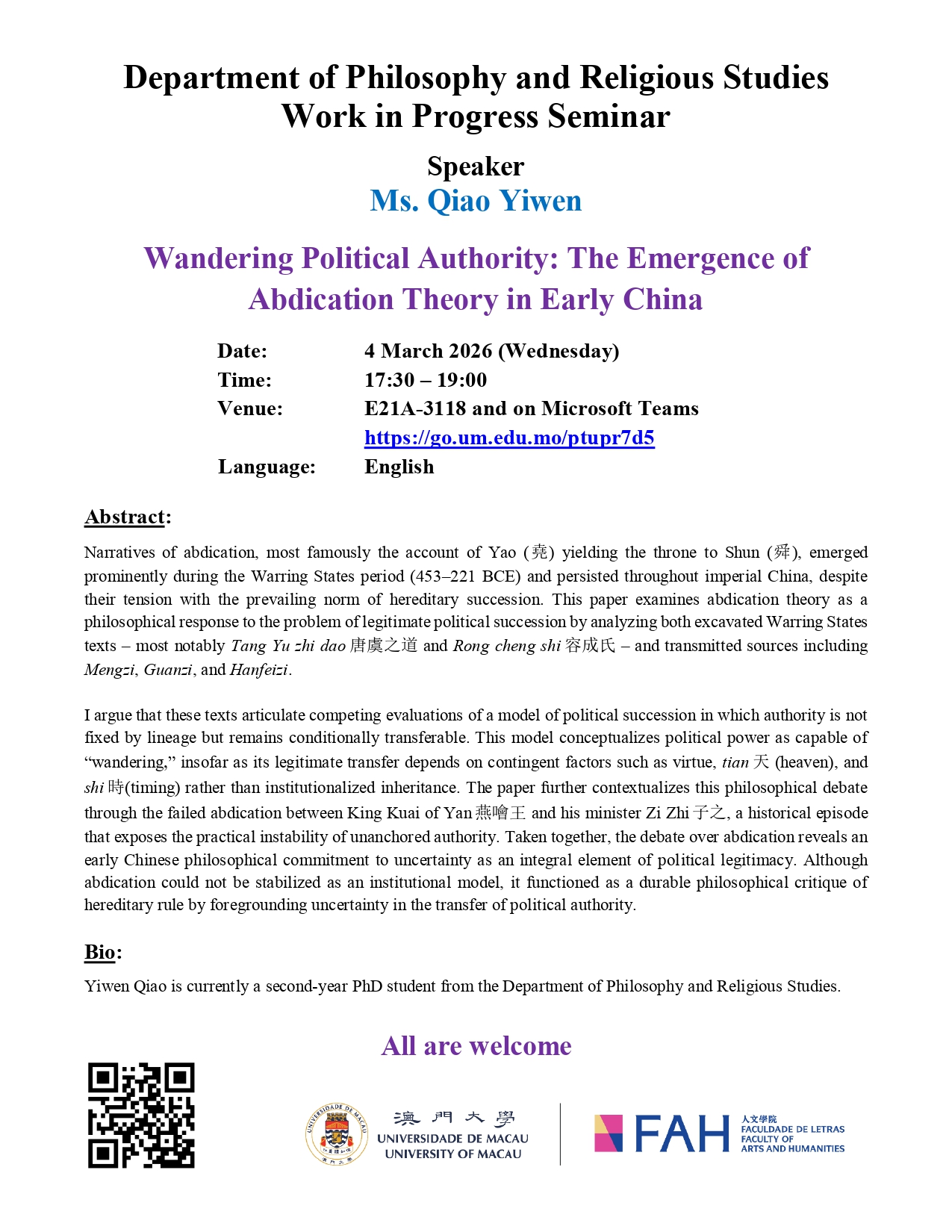
FAH/DPHIL Work-in-progress Seminar – “Wandering Political Authority: The Emergence of Abdication Theory in Early China” by Ms. Qiao Yiwen
2026-03-04 @ 5:30 pm ~ 7:00 pm
Microsoft Teams: https://go.um.edu.mo/ptupr7d5
Abstract
Narratives of abdication, most famously the account of Yao (堯) yielding the throne to Shun (舜), emerged prominently during the Warring States period (453–221 BCE) and persisted throughout imperial China, despite their tension with the prevailing norm of hereditary succession. This paper examines abdication theory as a philosophical response to the problem of legitimate political succession by analyzing both excavated Warring States texts – most notably Tang Yu zhi dao唐虞之道 and Rong cheng shi容成氏 – and transmitted sources including Mengzi, Guanzi, and Hanfeizi.
I argue that these texts articulate competing evaluations of a model of political succession in which authority is not fixed by lineage but remains conditionally transferable. This model conceptualizes political power as capable of “wandering,” insofar as its legitimate transfer depends on contingent factors such as virtue, tian天 (heaven), and shi時(timing) rather than institutionalized inheritance. The paper further contextualizes this philosophical debate through the failed abdication between King Kuai of Yan燕噲王 and his minister Zi Zhi子之, a historical episode that exposes the practical instability of unanchored authority. Taken together, the debate over abdication reveals an early Chinese philosophical commitment to uncertainty as an integral element of political legitimacy. Although abdication could not be stabilized as an institutional model, it functioned as a durable philosophical critique of hereditary rule by foregrounding uncertainty in the transfer of political authority.
Bio
Yiwen Qiao is currently a second-year PhD student from the Department of Philosophy and Religious Studies.