
Calendar of Events
M Mon
T Tue
W Wed
T Thu
F Fri
S Sat
S Sun
0 events,
0 events,
0 events,
0 events,
0 events,
0 events,
0 events,
0 events,
0 events,
0 events,
0 events,
0 events,
0 events,
0 events,
0 events,
0 events,
1 event,
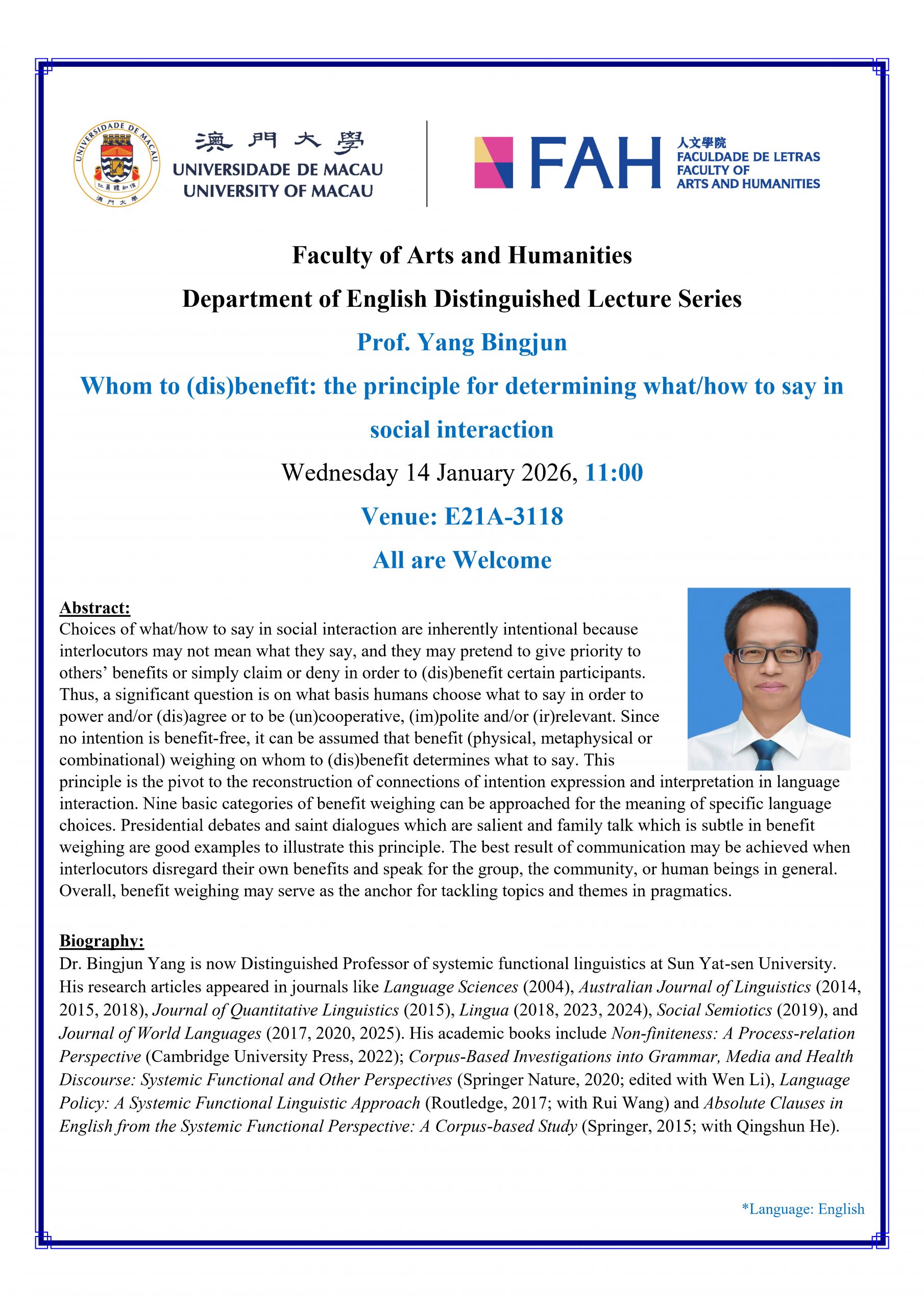
FAH-DENG Guest Lecture: “Whom to (dis)benefit: the principle for determining what/how to say in social interaction”
FAH-DENG Guest Lecture: “Whom to (dis)benefit: the principle for determining what/how to say in social interaction”
Abstract: Choices of what/how to say in social interaction are inherently intentional because interlocutors may not mean what they say, and they may pretend to give priority to others’ benefits or simply claim or deny in order to (dis)benefit certain participants. Thus, a significant question is on what basis humans choose what to say in order to power and/or (dis)agree or to be (un)cooperative, (im)polite and/or (ir)relevant. Since no intention is benefit-free, it can be assumed that benefit (physical, metaphysical or combinational) weighing on whom to (dis)benefit determines what to say. This principle is the pivot to the reconstruction of connections of intention expression and interpretation in language interaction. Nine basic categories of benefit weighing can be approached for the […]
0 events,
0 events,
0 events,
0 events,
0 events,
0 events,
0 events,
0 events,
1 event,
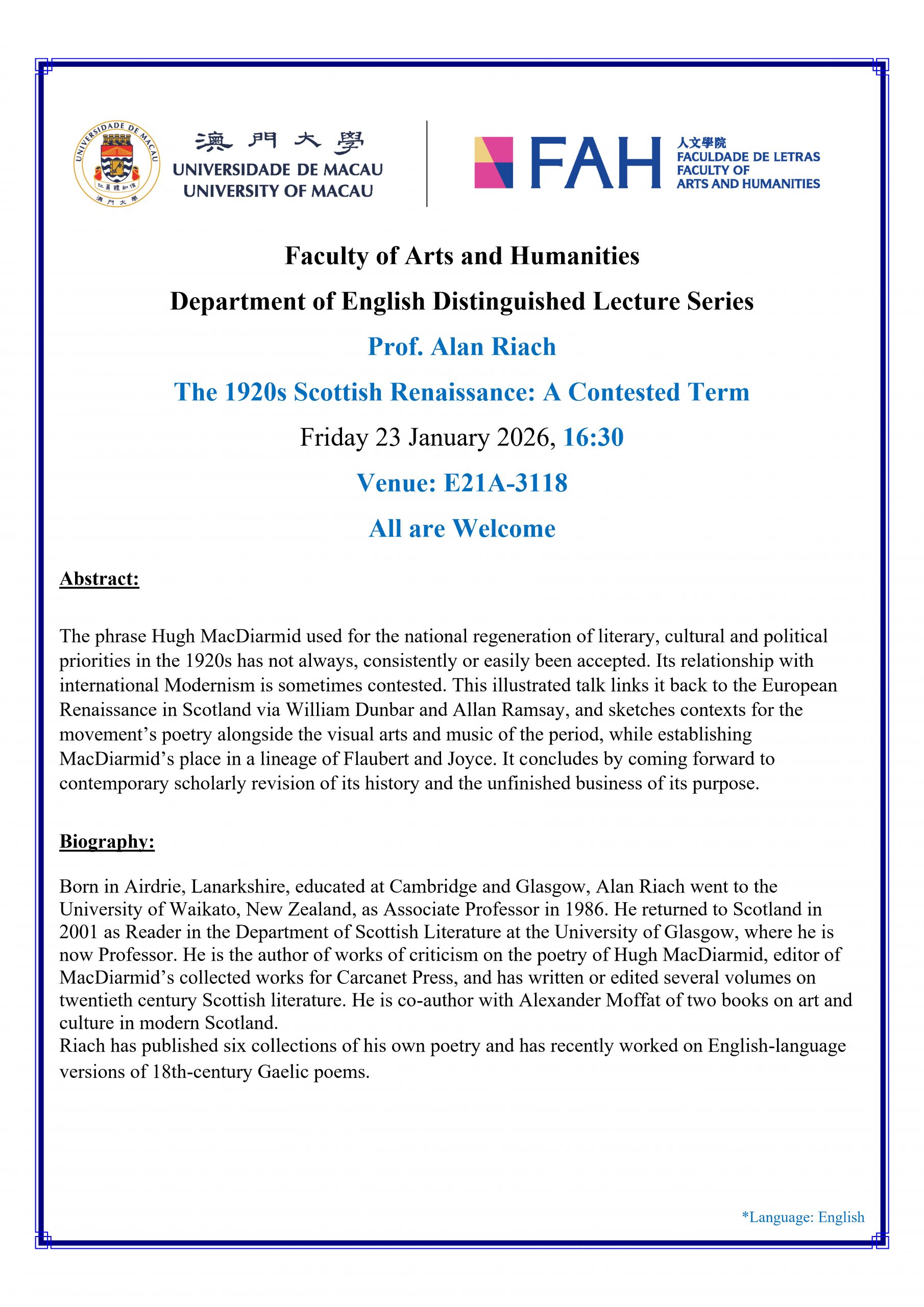
FAH-DENG Guest Lecture: “The 1920s Scottish Renaissance: A Contested Term”
FAH-DENG Guest Lecture: “The 1920s Scottish Renaissance: A Contested Term”
Abstract: The phrase Hugh MacDiarmid used for the national regeneration of literary, cultural and political priorities in the 1920s has not always, consistently or easily been accepted. Its relationship with international Modernism is sometimes contested. This illustrated talk links it back to the European Renaissance in Scotland via William Dunbar and Allan Ramsay, and sketches contexts for the movement’s poetry alongside the visual arts and music of the period, while establishing MacDiarmid’s place in a lineage of Flaubert and Joyce. It concludes by coming forward to contemporary scholarly revision of its history and the unfinished business of its purpose. Biography: Born in Airdrie, Lanarkshire, educated at Cambridge and Glasgow, Alan Riach went to the University of Waikato, New Zealand, as […]
0 events,
0 events,
0 events,
0 events,
1 event,
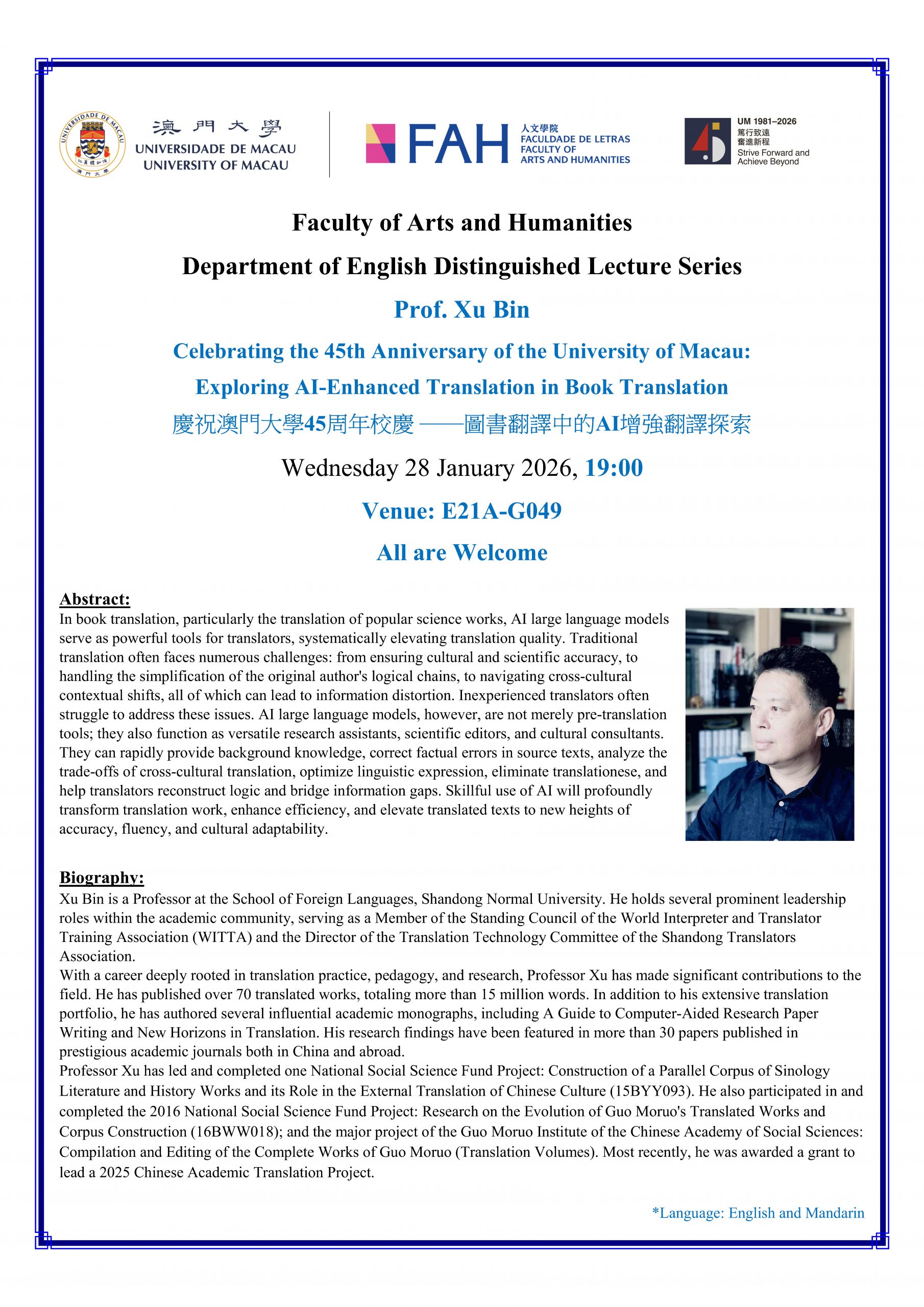
FAH – DENG Guest Lecture: “Exploring AI-Enhanced Translation in Book Translation”
FAH – DENG Guest Lecture: “Exploring AI-Enhanced Translation in Book Translation”
Abstract: In book translation, particularly the translation of popular science works, AI large language models serve as powerful tools for translators, systematically elevating translation quality. Traditional translation often faces numerous challenges: from ensuring cultural and scientific accuracy, to handling the simplification of the original author's logical chains, to navigating cross-cultural contextual shifts, all of which can lead to information distortion. Inexperienced translators often struggle to address these issues. AI large language models, however, are not merely pre-translation tools; they also function as versatile research assistants, scientific editors, and cultural consultants. They can rapidly provide background knowledge, correct factual errors in source texts, analyze the trade-offs of cross-cultural translation, optimize linguistic expression, eliminate translationese, and help translators reconstruct logic and bridge […]
1 event,
FAH-DENG Guest Lecture: “From AIPE to AIAT: Translation in the Age of Artificial Intelligence”
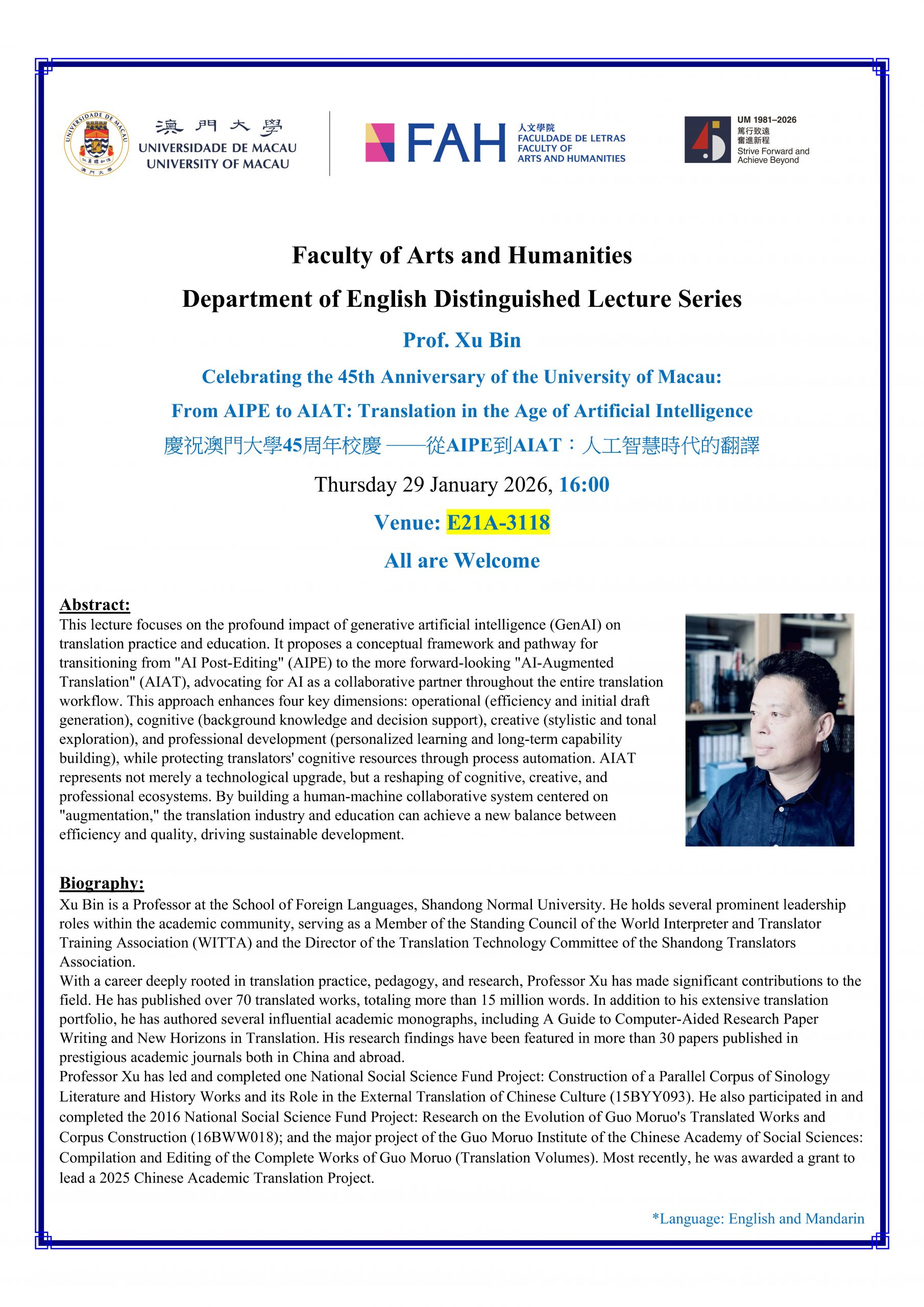
FAH-DENG Guest Lecture: “From AIPE to AIAT: Translation in the Age of Artificial Intelligence”
Abstract: This lecture focuses on the profound impact of generative artificial intelligence (GenAI) on translation practice and education. It proposes a conceptual framework and pathway for transitioning from "AI Post-Editing" (AIPE) to the more forward-looking "AI-Augmented Translation" (AIAT), advocating for AI as a collaborative partner throughout the entire translation workflow. This approach enhances four key dimensions: operational (efficiency and initial draft generation), cognitive (background knowledge and decision support), creative (stylistic and tonal exploration), and professional development (personalized learning and long-term capability building), while protecting translators' cognitive resources through process automation. AIAT represents not merely a technological upgrade, but a reshaping of cognitive, creative, and professional ecosystems. By building a human-machine collaborative system centered on "augmentation," the translation industry and education […]