

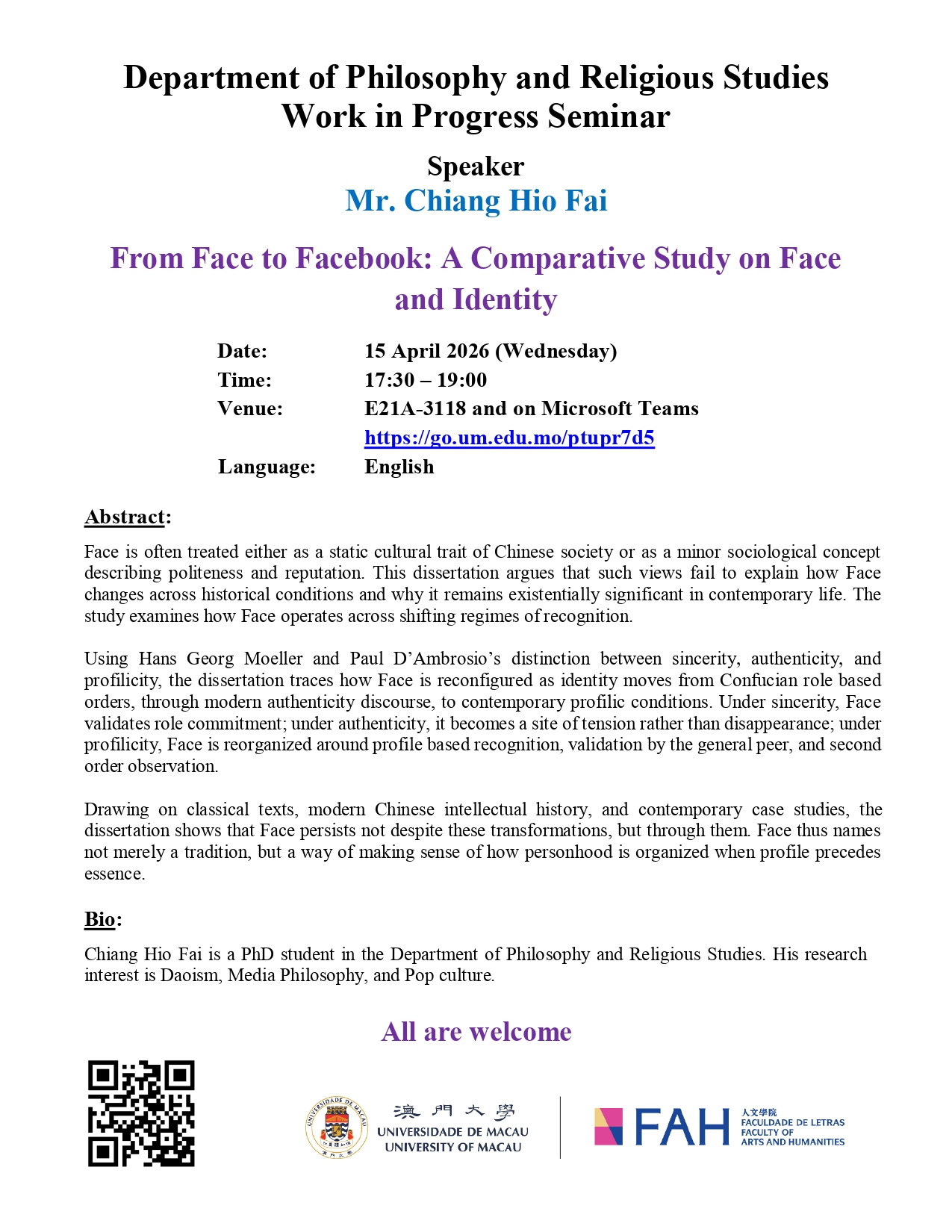
FAH/DPHIL Work-in-progress Seminar – “From Face to Facebook: A Comparative Study on Face and Identity” by Mr. Chiang Hio Fai
2026-04-15 @ 5:30 下午 ~ 7:00 下午
Microsoft Teams: https://go.um.edu.mo/ptupr7d5
Abstract
Face is often treated either as a static cultural trait of Chinese society or as a minor sociological concept describing politeness and reputation. This dissertation argues that such views fail to explain how Face changes across historical conditions and why it remains existentially significant in contemporary life. The study examines how Face operates across shifting regimes of recognition.
Using Hans Georg Moeller and Paul D’Ambrosio’s distinction between sincerity, authenticity, and profilicity, the dissertation traces how Face is reconfigured as identity moves from Confucian role based orders, through modern authenticity discourse, to contemporary profilic conditions. Under sincerity, Face validates role commitment; under authenticity, it becomes a site of tension rather than disappearance; under profilicity, Face is reorganized around profile based recognition, validation by the general peer, and second order observation.
Drawing on classical texts, modern Chinese intellectual history, and contemporary case studies, the dissertation shows that Face persists not despite these transformations, but through them. Face thus names not merely a tradition, but a way of making sense of how personhood is organized when profile precedes essence.
Bio
Chiang Hio Fai is a PhD student in the Department of Philosophy and Religious Studies. His research interest is Daoism, Media Philosophy, and Pop culture.