
On the afternoon of March 20th, Professor Lu Jianming and Professor Ma Zhen from the Department of Chinese Language and Literature of Peking University were invited to deliver two insightful seminars titled “Information Packaging” and “Comparison – The Fundamental Method of Linguistic Research” at E21-G049 of the Faculty of Arts and Humanities, University of Macau. The seminars are a profound academic feast that enriched knowledge and inspired innovative thinking, were attended by numerous teachers and students majoring in linguistics, with Professor Xu Jie, Dean of the Faculty of Arts and Humanities, presiding over the session and Professor Yuan Yulin also in attendance.
Professor Lu Jianming: Information Packaging – The Cognitive Logic Behind Linguistic Expression
In his seminar, Professor Lu Jianming systematically elaborated on “information packaging”, a core concept in linguistics. He pointed out that as an essential component of the linguistic information structure theory, information packaging refers to the speaker’s act of “packaging” content into linguistically accessible forms tailored to the context and the listener’s cognitive state, thereby enabling effective communication. Professor Lu vividly compared information to a “gift” and linguistic forms to “wrapping paper”, noting that the choice of different sentence patterns essentially reflects distinct information packaging strategies.
He detailed the practical applications of information packaging across a diverse range of scenarios, including daily communication, science and technology, academic research, business communication, legal interpretation, and medical diagnosis. He emphasized that the information packaging theory boasts extensive application value in syntactic and discourse analysis, cross-linguistic comparative studies, and pragmatic and conversational research.
When discussing grammar teaching, Professor Lu highlighted that the information packaging theory can transform grammar instruction from “memorizing rules” to “applying functions”, and from “pursuing grammatical correctness” to “achieving pragmatic effectiveness”. He also explored the potential of artificial intelligence (AI) technology in applying the information packaging theory to grammar teaching, arguing that data-driven and scenario-based interactive approaches can effectively enhance learners’ linguistic competence.
Finally, Professor Lu looked ahead to the development trends of the information packaging theory, stating that it will continue to evolve in five key directions: further integration with other linguistic theories, facilitation of discourse analysis, expansion of cross-linguistic research, adoption of AI technologies, and greater attention to socio-cultural factors.
Professor Ma Zhen: Comparison – The Fundamental Method of Linguistic Research
Professor Ma Zhen delivered a seminar titled “Comparison – The Fundamental Method of Linguistic Research”. Drawing on her decades of rich experience in the research and teaching of modern Chinese function words, she explained the pivotal role of the comparative method in linguistic research in a simple and in-depth manner.
Professor Ma noted that mastering the comparative method is crucial for both Chinese and other linguistic research. She systematically introduced four types of comparative analysis: contrasting synonymous or near-synonymous function words, comparing function words that address the same linguistic issue, contrasting antonymous function words, and comparing sentences with a specific function word against those without it. Through a wealth of vivid examples of function word discrimination, such as zhi (only), dou (all), jing (merely), cengjing (once), yijing (already), and changchang (often), wangwang (usually), she demonstrated how the comparative method helps researchers accurately grasp the grammatical meaning of function words.
She stressed that linguistic research requires multi-angle, multi-dimensional and multi-level comparisons, and advocated for a “peeling the bamboo shoot” approach – conducting in-depth, iterative analysis and continuous verification. Taking the discrimination between changchang and wangwang as a case in point, she vividly illustrated how research conclusions are gradually revised and refined through constant testing of linguistic data, ultimately identifying their essential distinction in terms of “frequency” and “regularity”. She particularly pointed out that challenging one’s own conclusions is a means to better validate them, and this habit of iterative thinking is indispensable for scientific research.
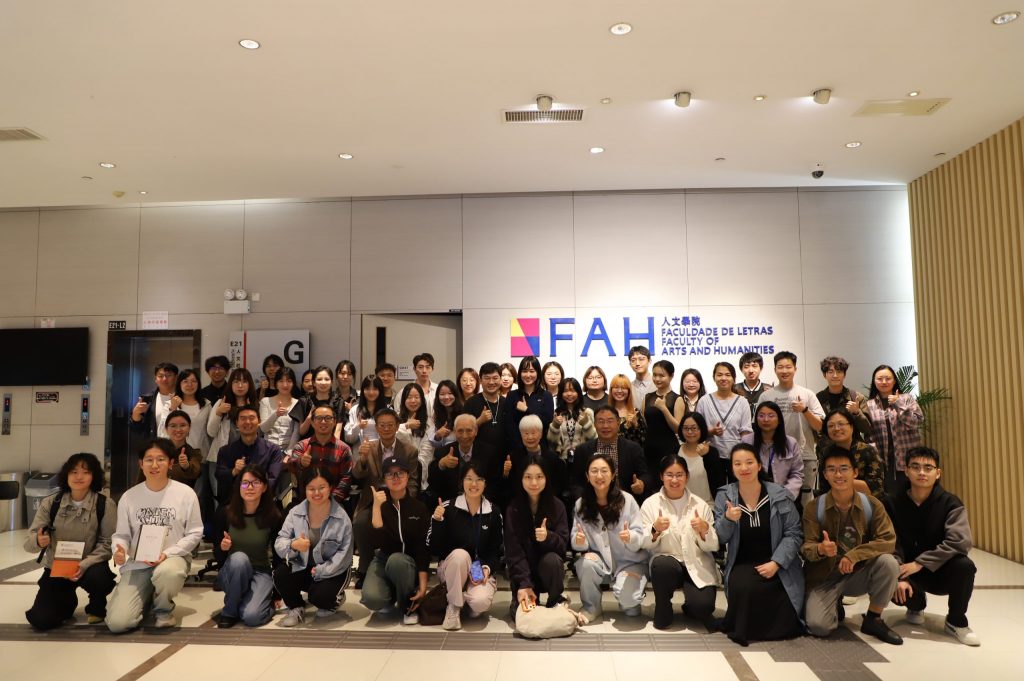
The seminars by the two professors combined theoretical profundity with abundant practical examples, presenting complex linguistic theories in an accessible and engaging way and fully demonstrating the rigor and practicality of linguistic research. The venue was filled with a lively atmosphere; during the interactive Q&A session, teachers and students raised questions enthusiastically, and the two professors responded patiently with in-depth explanations. After the seminars, the participants took a group photo with Professor Lu and Professor Ma. Many students also brought the professors’ works to ask for Professor Lu’s autograph, expressing their profound admiration for him. These seminars not only provided a precious opportunity for teachers and students of the University of Macau to communicate face-to-face with renowned linguists, but also contributed to promoting the innovation and development of linguistic research methods.