
Calendar of Events
M Mon
T Tue
W Wed
T Thu
F Fri
S Sat
S Sun
1 event,

FAH/DPHIL: The Mario Echano Prize for the Best Undergraduate Philosophy Essay
The Mario Echano Prize for the Best Undergraduate Philosophy Essay is awarded for excellence in philosophy. Students enrolled in the Department of Philosophy and Religious Studies undergraduate courses are eligible to enter an essay for the annual award. Students are invited to submit an academic essay written as an assignment in one of the Department of Philosophy and Religious Studies’ undergraduate courses this academic year (AY2025/2026). Essays of any length are acceptable. The organisers reserve the right not to award the prize if essays are not of sufficiently high standard. Please submit essays by e-mail with the subject line ‘Submission for the Mario Echano Prize’ to Maggie Wong at MaggieWong@um.edu.mo. Attach your essay to the message as a Microsoft Word document (other […]
2 events,
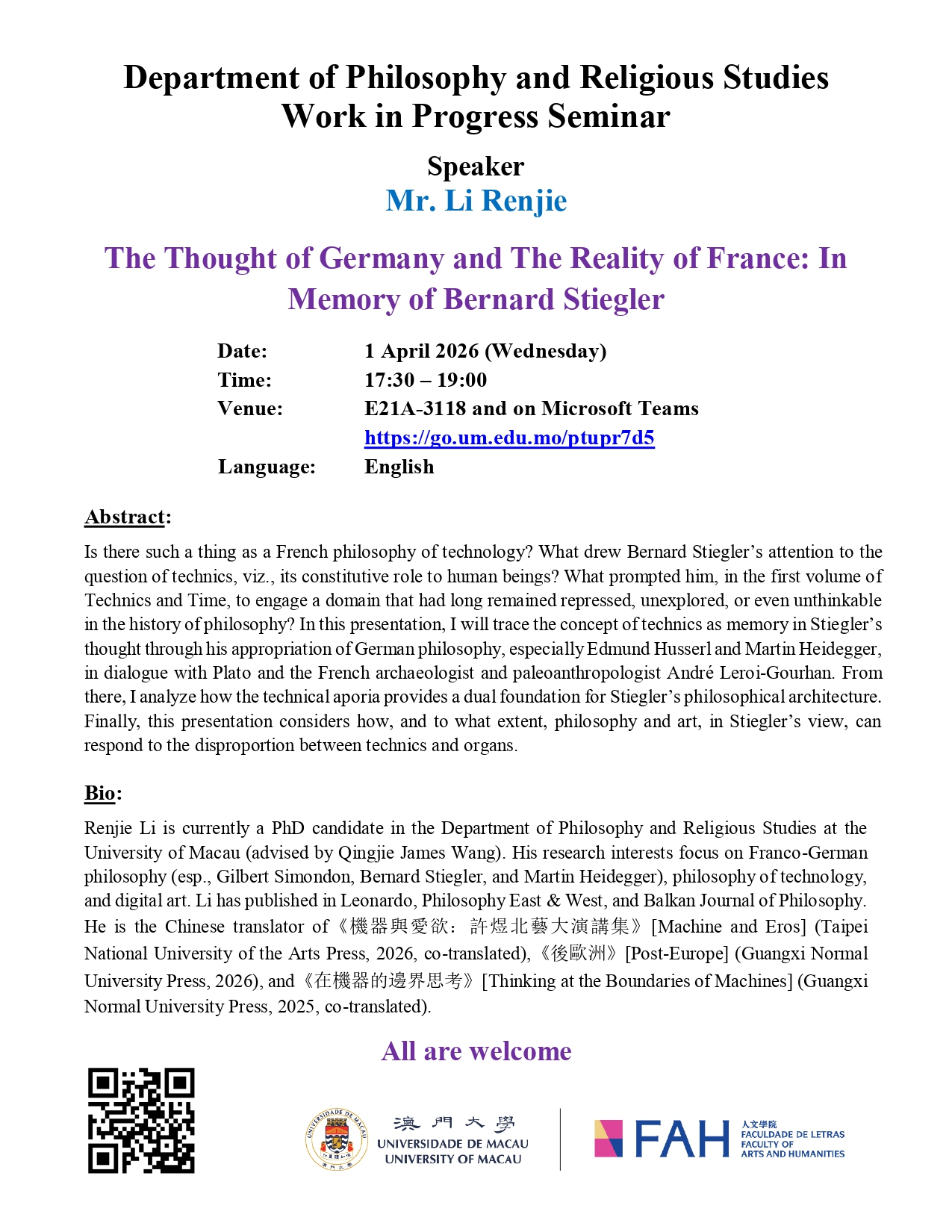
FAH/DPHIL Work-in-progress Seminar – “The Thought of Germany and The Reality of France: In Memory of Bernard Stiegler” by Mr. Li Renjie
FAH/DPHIL Work-in-progress Seminar – “The Thought of Germany and The Reality of France: In Memory of Bernard Stiegler” by Mr. Li Renjie
Microsoft Teams: https://go.um.edu.mo/ptupr7d5 Abstract Is there such a thing as a French philosophy of technology? What drew Bernard Stiegler’s attention to the question of technics, viz., its constitutive role to human beings? What prompted him, in the first volume of Technics and Time, to engage a domain that had long remained repressed, unexplored, or even unthinkable in the history of philosophy? In this presentation, I will trace the concept of technics as memory in Stiegler’s thought through his appropriation of German philosophy, especially Edmund Husserl and Martin Heidegger, in dialogue with Plato and the French archaeologist and paleoanthropologist André Leroi-Gourhan. From there, I analyze how the technical aporia provides a dual foundation for Stiegler’s philosophical architecture. Finally, this presentation […]
2 events,

2 events,
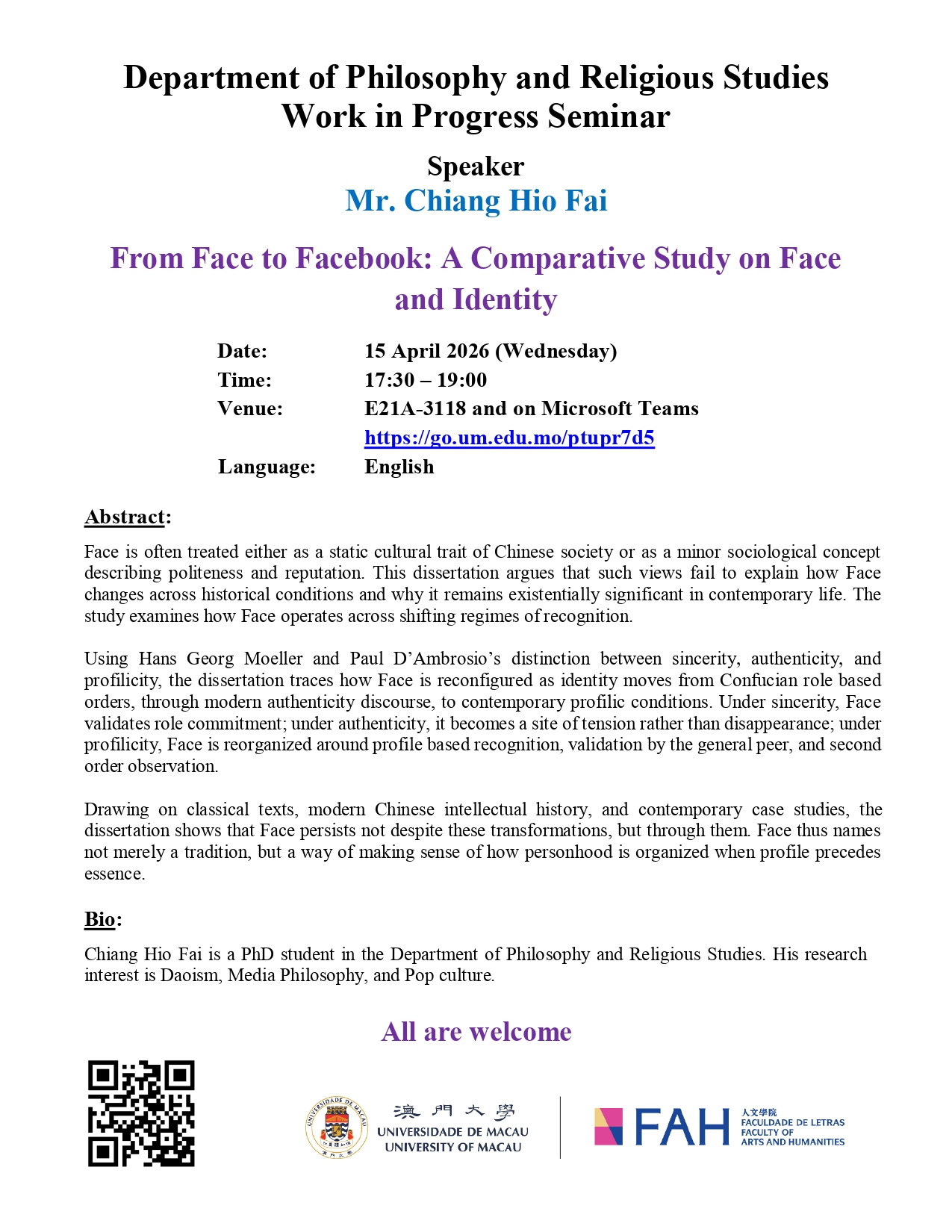
FAH/DPHIL Work-in-progress Seminar – “From Face to Facebook: A Comparative Study on Face and Identity” by Mr. Chiang Hio Fai
FAH/DPHIL Work-in-progress Seminar – “From Face to Facebook: A Comparative Study on Face and Identity” by Mr. Chiang Hio Fai
Microsoft Teams: https://go.um.edu.mo/ptupr7d5 Abstract Face is often treated either as a static cultural trait of Chinese society or as a minor sociological concept describing politeness and reputation. This dissertation argues that such views fail to explain how Face changes across historical conditions and why it remains existentially significant in contemporary life. The study examines how Face operates across shifting regimes of recognition. Using Hans Georg Moeller and Paul D’Ambrosio’s distinction between sincerity, authenticity, and profilicity, the dissertation traces how Face is reconfigured as identity moves from Confucian role based orders, through modern authenticity discourse, to contemporary profilic conditions. Under sincerity, Face validates role commitment; under authenticity, it becomes a site of tension rather than disappearance; under profilicity, Face is […]
2 events,
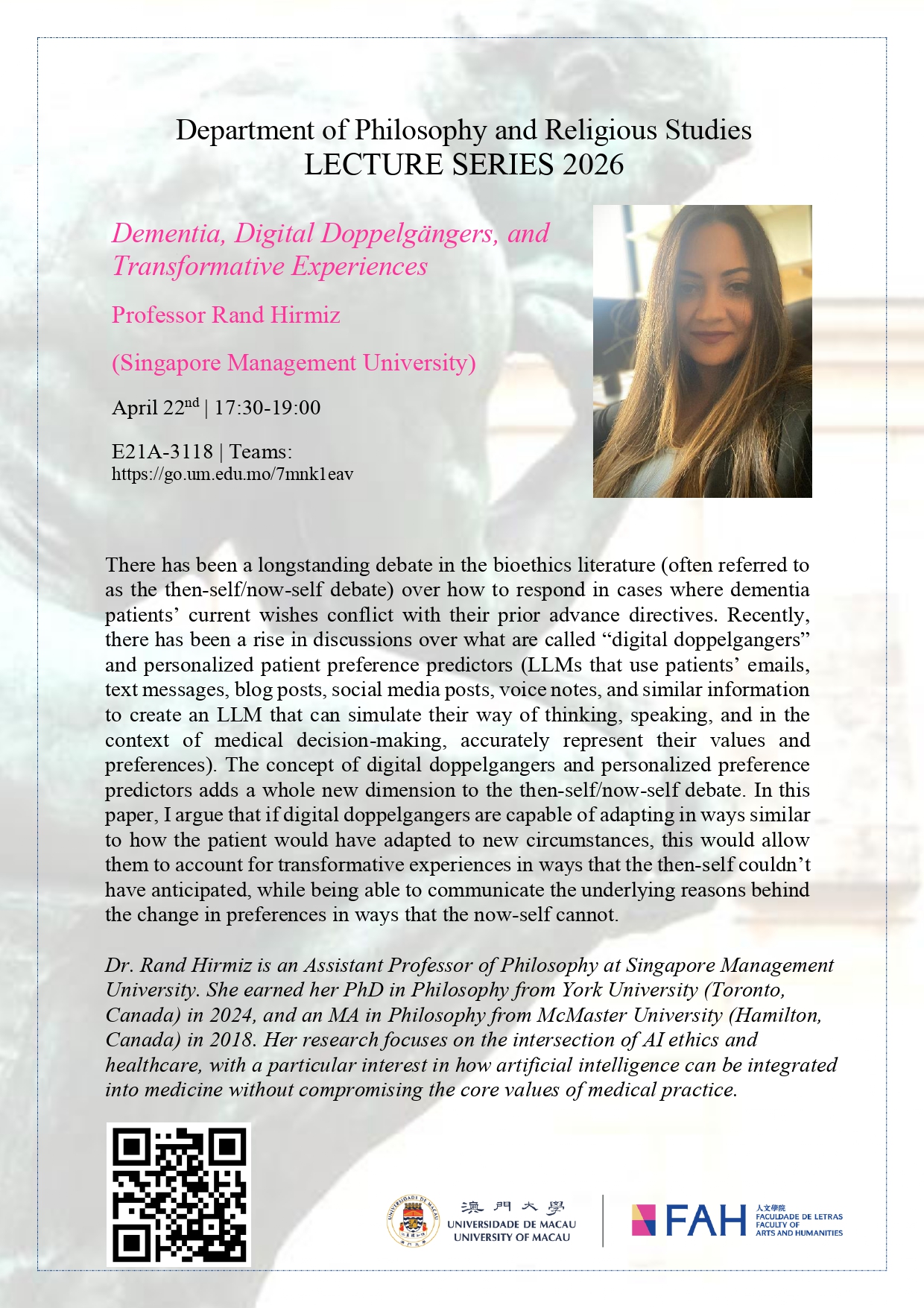
FAH/DPHIL Lecture Series – “Dementia, Digital Doppelgängers, and Transformative Experiences” by Prof. Rand Hirmiz, Singapore Management University, Singapore
FAH/DPHIL Lecture Series – “Dementia, Digital Doppelgängers, and Transformative Experiences” by Prof. Rand Hirmiz, Singapore Management University, Singapore
Microsoft Teams: https://go.um.edu.mo/7mnk1eav Abstract There has been a longstanding debate in the bioethics literature (often referred to as the then-self/now-self debate) over how to respond in cases where dementia patients’ current wishes conflict with their prior advance directives. Recently, there has been a rise in discussions over what are called “digital doppelgangers” and personalized patient preference predictors (LLMs that use patients’ emails, text messages, blog posts, social media posts, voice notes, and similar information to create an LLM that can simulate their way of thinking, speaking, and in the context of medical decision-making, accurately represent their values and preferences). The concept of digital doppelgangers and personalized preference predictors adds a whole new dimension to the then-self/now-self debate. In this […]