
Calendar of Events
M Mon
T Tue
W Wed
T Thu
F Fri
S Sat
S Sun
0 events,
0 events,
0 events,
0 events,
0 events,
0 events,
0 events,
0 events,
0 events,
1 event,
FAH/DPHIL Work-in-progress Seminar – “Wandering Political Authority: The Emergence of Abdication Theory in Early China” by Ms. Qiao Yiwen
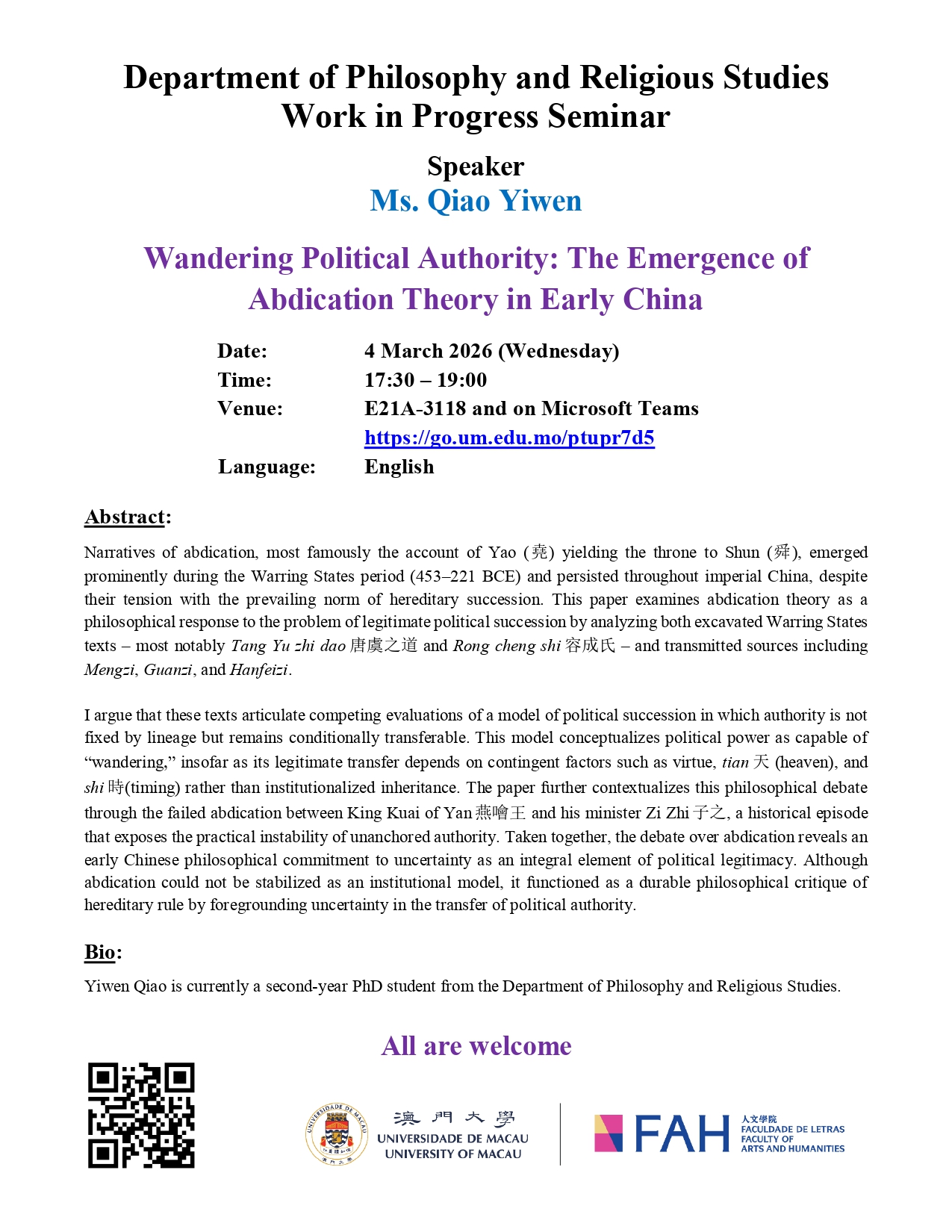
FAH/DPHIL Work-in-progress Seminar – “Wandering Political Authority: The Emergence of Abdication Theory in Early China” by Ms. Qiao Yiwen
Microsoft Teams: https://go.um.edu.mo/ptupr7d5 Abstract Narratives of abdication, most famously the account of Yao (堯) yielding the throne to Shun (舜), emerged prominently during the Warring States period (453–221 BCE) and persisted throughout imperial China, despite their tension with the prevailing norm of hereditary succession. This paper examines abdication theory as a philosophical response to the problem of legitimate political succession by analyzing both excavated Warring States texts – most notably Tang Yu zhi dao唐虞之道 and Rong cheng shi容成氏 – and transmitted sources including Mengzi, Guanzi, and Hanfeizi. I argue that these texts articulate competing evaluations of a model of political succession in which authority is not fixed by lineage but remains conditionally transferable. This model conceptualizes political power as […]
0 events,
0 events,
0 events,
0 events,
2 events,

FAH/DPHIL: The Mario Echano Prize for the Best Undergraduate Philosophy Essay
The Mario Echano Prize for the Best Undergraduate Philosophy Essay is awarded for excellence in philosophy. Students enrolled in the Department of Philosophy and Religious Studies undergraduate courses are eligible to enter an essay for the annual award. Students are invited to submit an academic essay written as an assignment in one of the Department of Philosophy and Religious Studies’ undergraduate courses this academic year (AY2025/2026). Essays of any length are acceptable. The organisers reserve the right not to award the prize if essays are not of sufficiently high standard. Please submit essays by e-mail with the subject line ‘Submission for the Mario Echano Prize’ to Maggie Wong at MaggieWong@um.edu.mo. Attach your essay to the message as a Microsoft Word document (other […]
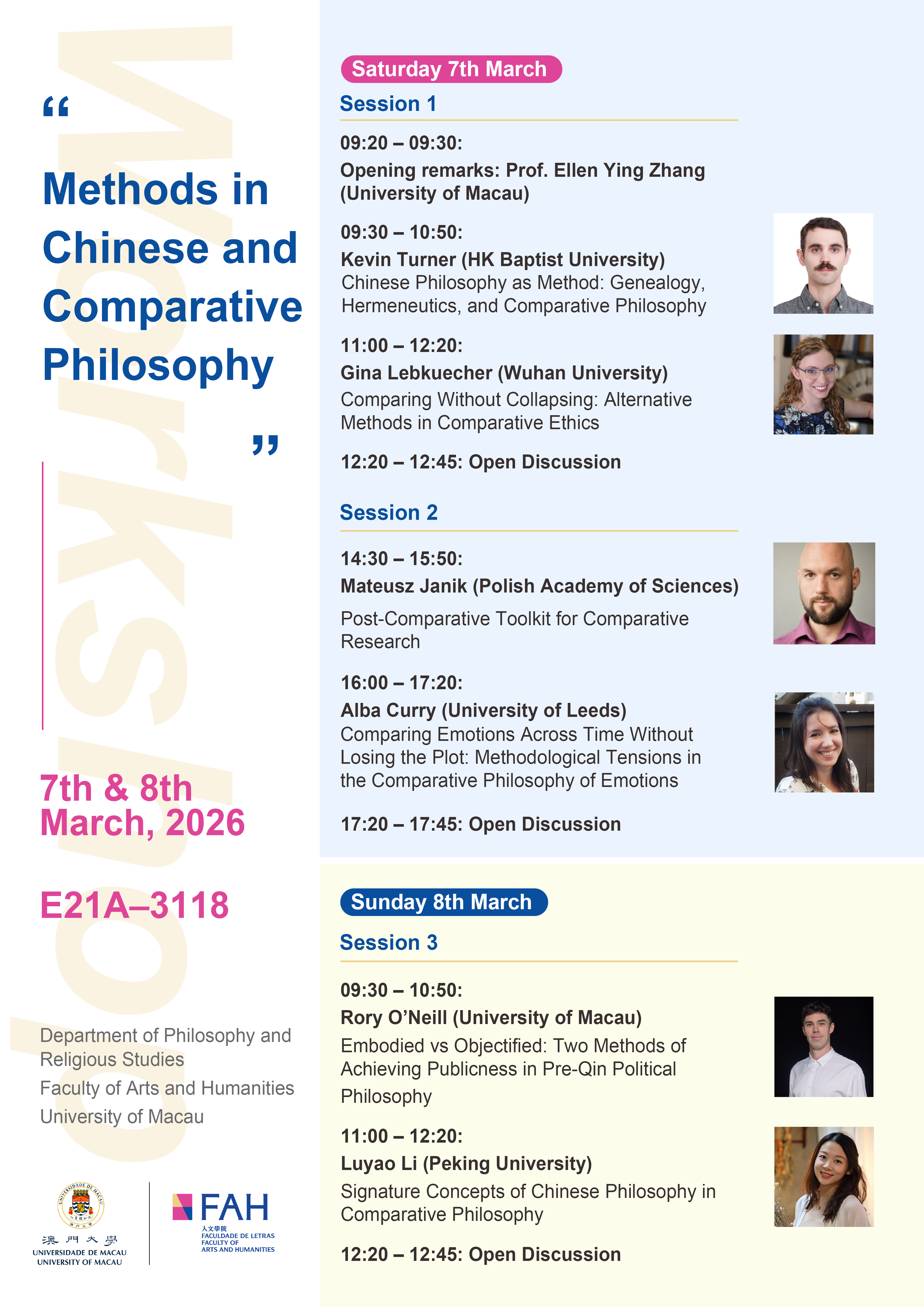
FAH/DPHIL Lecture Series – “Mandarin Robes, Jesuit Body: Accommodation and the Early Modern Origins of Comparative Philosophy” by Prof. Mateusz Janik, Polish Academy of Sciences, Poland

FAH/DPHIL Lecture Series – “Mandarin Robes, Jesuit Body: Accommodation and the Early Modern Origins of Comparative Philosophy” by Prof. Mateusz Janik, Polish Academy of Sciences, Poland
Microsoft Teams: https://go.um.edu.mo/7mnk1eav Abstract The first Jesuit missionaries who entered China, landing first in Macao, adopted Chinese attire, learned the Chinese language, and adapted the Christian message to Chinese culture. This is often understood as a successful hermeneutic practice that facilitated intellectual exchange between China and Europe. The Jesuit reception of Chinese thought may be viewed as one of the founding moments of comparative philosophy. It is also a fascinating case study for observing the process of intellectual transmission between two distinct cultures. By examining how ideas change and interact in different conceptual environments, we can grasp the formation of new philosophical concepts, discursive spaces, and intercultural identities. In this lecture, we will examine the philosophical assumptions and challenges […]


2 events,
FAH/DPHIL Lecture Series – “From Populist Deconsolidation to Neo-Reactionary Rupture: Rethinking the Liberal Paradigm” by Prof. Enrico Biale, University of Piemonte Orientale, Italy
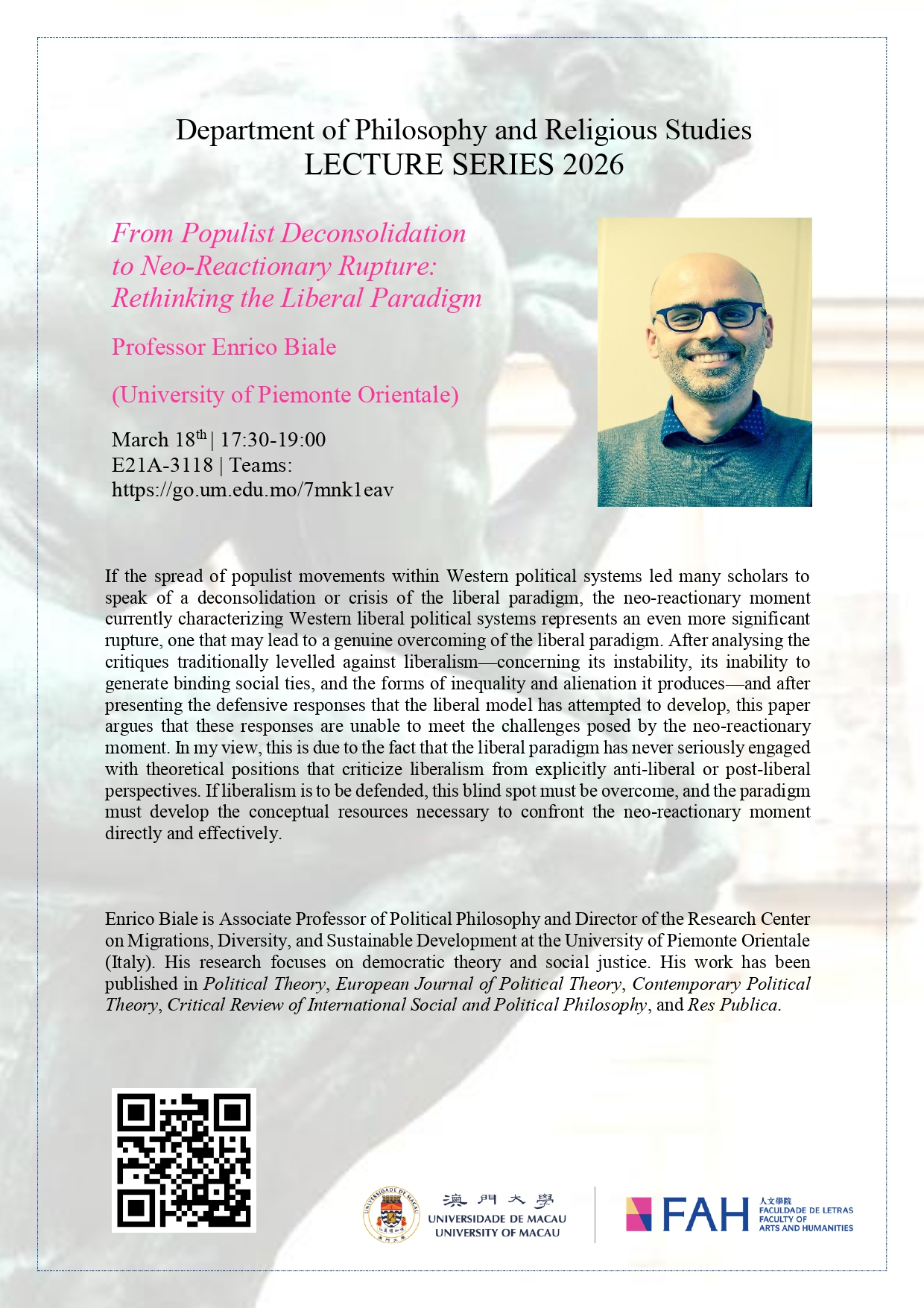
FAH/DPHIL Lecture Series – “From Populist Deconsolidation to Neo-Reactionary Rupture: Rethinking the Liberal Paradigm” by Prof. Enrico Biale, University of Piemonte Orientale, Italy
Microsoft Teams: https://go.um.edu.mo/7mnk1eav Abstract If the spread of populist movements within Western political systems led many scholars to speak of a deconsolidation or crisis of the liberal paradigm, the neo-reactionary moment currently characterizing Western liberal political systems represents an even more significant rupture, one that may lead to a genuine overcoming of the liberal paradigm. After analysing the critiques traditionally levelled against liberalism—concerning its instability, its inability to generate binding social ties, and the forms of inequality and alienation it produces—and after presenting the defensive responses that the liberal model has attempted to develop, this paper argues that these responses are unable to meet the challenges posed by the neo-reactionary moment. In my view, this is due to the […]
2 events,
FAH/DPHIL Lecture Series – “Recalcitrance, Rationality, and the Nature of Emotion” by Prof. Adam Bradley, Lingnan University, Hong Kong
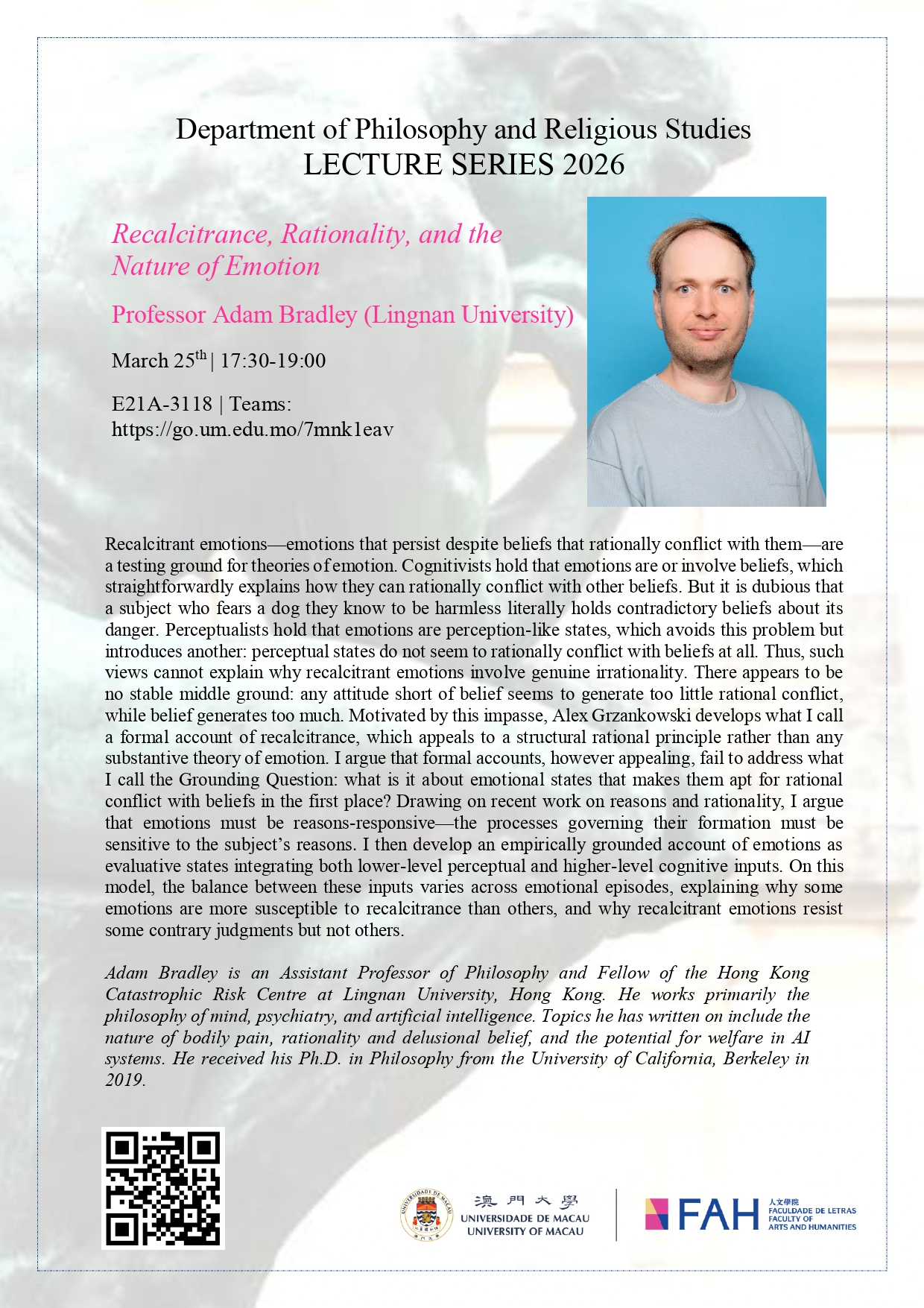
FAH/DPHIL Lecture Series – “Recalcitrance, Rationality, and the Nature of Emotion” by Prof. Adam Bradley, Lingnan University, Hong Kong
Microsoft Teams: https://go.um.edu.mo/7mnk1eav Abstract Recalcitrant emotions—emotions that persist despite beliefs that rationally conflict with them—are a testing ground for theories of emotion. Cognitivists hold that emotions are or involve beliefs, which straightforwardly explains how they can rationally conflict with other beliefs. But it is dubious that a subject who fears a dog they know to be harmless literally holds contradictory beliefs about its danger. Perceptualists hold that emotions are perception-like states, which avoids this problem but introduces another: perceptual states do not seem to rationally conflict with beliefs at all. Thus, such views cannot explain why recalcitrant emotions involve genuine irrationality. There appears to be no stable middle ground: any attitude short of belief seems to generate too little […]
2 events,

2 events,
FAH/DPHIL Work-in-progress Seminar – “The Thought of Germany and The Reality of France: In Memory of Bernard Stiegler” by Mr. Li Renjie
FAH/DPHIL Work-in-progress Seminar – “The Thought of Germany and The Reality of France: In Memory of Bernard Stiegler” by Mr. Li Renjie
Microsoft Teams: https://go.um.edu.mo/ptupr7d5 Abstract Is there such a thing as a French philosophy of technology? What drew Bernard Stiegler’s attention to the question of technics, viz., its constitutive role to human beings? What prompted him, in the first volume of Technics and Time, to engage a domain that had long remained repressed, unexplored, or even unthinkable in the history of philosophy? In this presentation, I will trace the concept of technics as memory in Stiegler’s thought through his appropriation of German philosophy, especially Edmund Husserl and Martin Heidegger, in dialogue with Plato and the French archaeologist and paleoanthropologist André Leroi-Gourhan. From there, I analyze how the technical aporia provides a dual foundation for Stiegler’s philosophical architecture. Finally, this presentation […]